
Lösung anfordern
DE-DE▼
Dieses Produkt ist mit Geräten und Anwendungen der folgenden Marken kompatibel oder für sie geeignet; dient nur als Auswahlhilfe. Marken sind Eigentum ihrer jeweiligen Inhaber und bedeuten keine Partnerschaft oder Billigung.
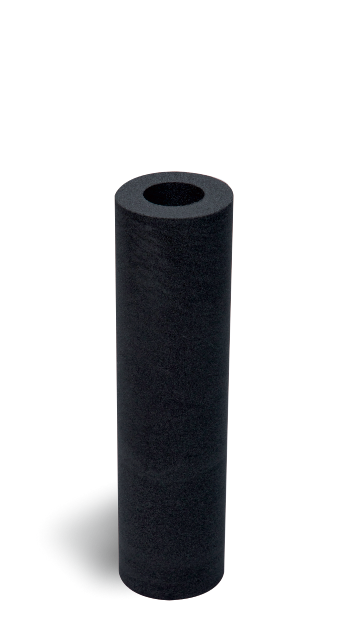
The Jyntrel Ф32×106 sintered activated carbon rod is a coconut-shell carbon block with built-in food-grade ion exchange resin, sized at 32 mm outside diameter and 106 mm in length. It filters household drinking water and appliance water lines, reducing residual chlorine, off-tastes and odours, colour, and heavy metals such as lead and mercury, while the resin helps soften water and limit scaling. It is made for water purifier and RO system builders, refrigerator and direct-drinking dispenser manufacturers, shower filter assemblers, and commercial coffee machine integrators who need a compact, repeatable carbon stage in the water path. Jyntrel manufactures it in Zhongshan, Guangdong, China, with dimensions flexible from Ф30 to Ф60.
This is a water-side component, so the design conversation starts with the hydraulic path rather than air. Water enters the outer surface of the sintered rod, passes through the porous carbon wall, and leaves through the core; the pressure drop across that wall, the flow the appliance can deliver, and the inlet water quality decide how the rod behaves in service. A uniform microporous structure keeps the initial flow high, which matters on low-pressure household lines and on compact dispensers where the pump head is limited.
Because the rod is sintered rather than loosely filled, it holds its shape under flow and does not release fine black carbon particles downstream. That behaviour is important where the carbon stage sits ahead of a membrane or a post-polishing stage, and where the appliance runs intermittently: start-up surges, air pockets after a cartridge change, and long idle periods in warm cabinets all stress a filter body. The ion exchange resin inside the rod works alongside the carbon, exchanging hardness-forming ions and supporting the reduction of heavy metals, which helps protect downstream surfaces from scale in hard-water regions.
The carbon is a high-iodine-value coconut shell grade, chosen for adsorption capacity and for the strength of the sintered body. In service the rod targets residual chlorine from municipal disinfection, odour and taste compounds, colour, organic matter, and volatile organic compounds, and it is rated for the reduction of harmful heavy metals including lead and mercury. The even pore structure gives high filtration accuracy with a large saturated adsorption capacity, so the service life is long relative to the compact size of the part.
The resin component adds a softening function: it reduces hardness ions that cause scaling and supports heavy-metal removal. For appliance builders this means one small part covers taste and odour control plus a degree of scale protection, which can simplify the water train in refrigerators, direct-drinking dispensers, and coffee equipment where space inside the housing is tight. Fluoride and other contaminants outside the stated scope should be handled by a dedicated stage, not assumed from this carbon rod.
Jyntrel supports OEM and ODM work on this sintered carbon rod. Length, diameter, and the ratio between outer and inner diameter can be tooled to the device, and end-cap welding is available where the housing design calls for it. Common reference sizes include Ф60×130, Ф62×240, Ф37.5×75, Ф38×57, Ф40×195, Ф51×127, Ф32×126, and Ф32×106 mm; the Ф32×106 version on this page is one point in that range, not a fixed limit.
To quote accurately we ask for the device or appliance model, the required size or a drawing of the housing and connections, the water flow rate the system must deliver, the operating conditions (inlet water quality, pressure, temperature, duty cycle), and the order quantity. If the rod must mate with an existing cap or manifold, send that interface detail as well; it determines whether a standard body or a tooled one is the right starting point.
| Item | Detail |
|---|---|
| Product name | Carbon block water filter for water purifiers and refrigerators (CTO filter) |
| Core filtration materials | High-iodine-value coconut shell activated carbon plus food-grade ion exchange resin |
| Core performance | Softens water and limits scaling; strongly adsorbs residual chlorine (bleaching powder); removes off-colour and odour; intercepts harmful heavy metals such as lead and mercury |
| Accuracy and service life | Uniform microporous structure, high initial flow, high filtration accuracy with no black carbon dust release; large saturated adsorption capacity and long service life |
| Common reference sizes (outside diameter × length, mm) | Ф60×130 / Ф62×240 / Ф37.5×75 / Ф38×57 / Ф40×195 / Ф51×127 / Ф32×126 / Ф32×106 |
| Main end applications | Household reverse osmosis purifiers (RO pre-stage CTO or post-stage T33), direct-drinking dispensers, built-in refrigerator water filters, commercial coffee machines |
| Customisation | Full OEM/ODM support: length, diameter, and inner/outer diameter ratio tooled to the device; end-cap welding available |
| Quality system | ISO 9001 and IATF 16949 certified production; filter materials meet demanding drinking-water safety and hygiene standards, backed by a CNAS testing centre |
The Ф32×106 format suits compact housings where a short, small-diameter carbon stage is required. Typical placements are the pre-carbon (CTO) position ahead of the RO membrane in household purifiers, the post-carbon (T33) position for taste polishing, the filter cavity of built-in refrigerator water dispensers, small direct-drinking machines, and pre-filtration on commercial coffee machines where chlorine and scale both affect beverage quality.
Shower filter assemblies are a further use, since the same carbon and resin combination addresses chlorine and odour in wash water. In every case the rod is one stage in a train: match its capacity to the flow the appliance actually draws and to the water chemistry of the target market, and keep the replacement interval realistic for that duty.
Jyntrel runs multiple automated production lines with capacity of millions of pieces per month, and has exported filtration products to Europe, the United States, Japan, and Korea for more than 20 years, which supports stable supply for programme and aftermarket volumes. The plant covers 50,000 m², including 6 clean workshops totalling 20,000 m², and quality control follows IQC, IPQC, and OQC through the process.
The in-house laboratory is CNAS-accredited and can issue test reports for filtration efficiency, dust holding capacity, and resistance. The production site holds ISO 9001, ISO 14001, and ISO 45001 certification, and gained IATF 16949 automotive quality management certification in 2024. Products meet REACH and RoHS environmental requirements and compliance documents can be supplied. Over 1,000 filtration solutions have been developed to date, which is the base the custom tooling above draws on.
Send the device or vehicle model, the size or drawing, the airflow or water flow the system must handle, the operating conditions, and the quantity you expect. With those inputs we can confirm whether the Ф32×106 rod fits as standard or whether a tooled size is needed, and return a quotation built around your duty cycle. Start at our contact page.
The rod has a uniform microporous structure and high initial flow, so it performs well on compact appliance lines. Final suitability depends on the pressure drop your pump can overcome, so share the flow rate and inlet pressure and Jyntrel can confirm the fit against test data from the CNAS-accredited laboratory.
This is a water filter, so we need the water flow rate the system must deliver, the inlet pressure, the water temperature, and the duty cycle. For air-side or appliance housings, send the interface drawing so the rod body and any end caps can be matched.
Yes. Jyntrel supports OEM and ODM work, and length, diameter, and inner/outer diameter ratio can be tooled to the device, with end-cap welding available. The common range spans Ф30 to Ф60 mm outside diameter, with Ф32×106 as one reference size.
Service life depends on inlet water quality and the volume of water drawn; the saturated adsorption capacity of the coconut shell carbon is large for the size. Replace when chlorine breakthrough or taste change is detected, and set the interval from your own field data for the market.
Sample and quotation policy for this product follows the programme agreed with your sales contact, so state the size, flow, and quantity in your inquiry. Jyntrel can provide CNAS laboratory test reports for filtration efficiency, dust holding capacity, and resistance to support evaluation.
MOQ and lead time are set per product and order configuration; confirm them with Jyntrel when you send the device model, drawing, and quantity. Capacity of millions of pieces per month across automated lines supports both programme and aftermarket volumes.
The production site holds ISO 9001, ISO 14001, and ISO 45001, and gained IATF 16949 in 2024; products meet REACH and RoHS requirements with compliance documents available on request. The CNAS-accredited in-house laboratory issues the performance reports. Tell us your target market and we will confirm the applicable documentation in an inquiry.