
Solicitar propuesta
ES-ES▼
Este producto es compatible con los equipos y aplicaciones de las siguientes marcas, o apto para ellos, solo como referencia para la selección. Las marcas comerciales pertenecen a sus respectivos propietarios; no implican afiliación ni respaldo.
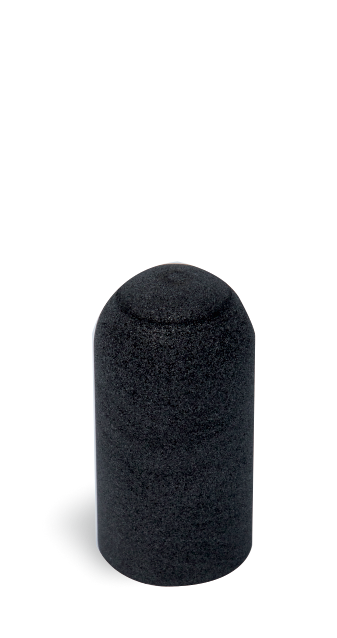
Jyntrel's sintered activated carbon stick filter Ф37.5×75 is a coconut-shell carbon block with built-in ion-exchange resin, designed to reduce chlorine, odours, colour and heavy metals in drinking water. It is used in household reverse-osmosis purifiers (as a pre-filter CTO or post-filter T33), direct-drinking dispensers, refrigerator water filters and commercial coffee machines. The cartridge is aimed at appliance makers, water-treatment brands and OEM/ODM buyers who need a stable, customisable carbon block for their own systems.
This filter belongs to the water path rather than the air path: it sits in the cold-water line of a purifier, dispenser or refrigerator, and everything about its behaviour is set by the flow and pressure in that line. At a rated flow of about 0.5–1.0 L/min, water passes radially through the sintered carbon wall; the pressure drop across the block stays low while the flow remains even, because the micro-pore structure is uniform through the wall.
For system designers, the practical questions are the same as on the air side: what is the incoming water quality, what flow must be delivered at the tap, and how much pressure budget is available? The Ф37.5×75 format suits compact housings where a short cartridge is preferred. The resin component works alongside the carbon: the carbon adsorbs residual chlorine and organic matter, while the resin exchanges hardness ions and helps hold back metals such as lead and mercury. Because the block is sintered as one piece, it does not shed loose carbon fines into the downstream line — a point that matters when the cartridge sits ahead of a membrane or a polished post-filter.
The carbon is a high-iodine-value coconut-shell grade, chosen for fast kinetics and a large adsorption capacity; the block therefore keeps a high chlorine-removal rate over its working life rather than fading quickly. Adsorption of residual chlorine (bleaching powder), off-flavours and odours, and colour is the primary duty, and the ion-exchange resin adds softening action that limits scale and supports heavy-metal reduction.
Filtration accuracy is in the 5–10 µm range, so the block also retains rust, sediment and other particulate matter carried in the feed water. The uniform pore structure gives a high initial flow with a high dirt-holding capacity, and the sintered body does not release black powder downstream. Service life is typically 3–6 months depending on feed-water quality and daily volume, and the cartridge should be replaced when chlorine breakthrough or a fall in flow is observed.
Jyntrel supports full OEM/ODM work on this family: length, diameter and the inner/outer diameter ratio can be set to the housing, and end-cap welding can be specified. Formulation is also flexible — iodine value, carbon-to-resin ratio, carbon type and the addition of KDF or silver-based bacteriostatic components can be discussed against your application. To quote accurately we ask for:
| Item | Detail |
|---|---|
| Product name | Carbon block water filter / CTO filter for water purifiers and refrigerators |
| Filter media | High-iodine-value coconut-shell activated carbon plus food-grade ion-exchange resin |
| Core performance | Softens water and limits scaling; adsorbs residual chlorine strongly; removes colour and odour; retains harmful heavy metals such as lead and mercury |
| Accuracy and life | Uniform micro-pore structure, high initial flow, fine filtration accuracy, no black-powder release; large saturated adsorption capacity and long service life |
| Standard sizes (OD × length, mm) | Ф60×130 / Ф62×240 / Ф37.5×75 / Ф38×57 / Ф40×195 / Ф51×127 / Ф32×126 / Ф32×106 |
| Main end uses | Household RO purifiers (pre-filter CTO / post-filter T33), direct-drinking dispensers, side-by-side refrigerator water filters, commercial coffee machines |
| Customisation | OEM/ODM supported; length, diameter and bore ratio made to the device; end-cap welding available |
| Quality system | 20,000 m² production base certified to ISO 9001 and IATF 16949; filter media meet potable-water safety standards; CNAS-accredited testing centre for quality control |
In a household RO system the cartridge is commonly used as the CTO stage ahead of the membrane, protecting it from chlorine and particulate load, or as a T33 polishing stage after the membrane to improve taste. In direct-drinking dispensers it provides the main chlorine and odour barrier in a compact envelope. Side-by-side refrigerators use it in the internal water line, where the short Ф37.5×75 body fits the available space. Commercial coffee machines use it to remove chlorine and hardness that would otherwise affect extraction and scale build-up in the boiler. Because sizes can be made to order, the same construction can be adapted to other small water appliances.
Jyntrel has more than 20 years of filter development and manufacturing experience and has been exporting to Europe, the United States, Japan and South Korea for over 20 years, which gives buyers a stable supply base. Multiple automated production lines support a monthly capacity of several million pieces, and more than 1,000 filter solutions have been developed to date.
The 50,000 m² plant in Zhongshan, Guangdong, includes six clean workshops totalling 20,000 m², where carbon blocks are produced in a controlled environment. The in-house laboratory is CNAS-accredited and can issue test reports on filtration efficiency, dust-holding capacity and resistance. The company holds ISO 9001, ISO 14001 and ISO 45001 certification and has been certified to IATF 16949 since 2024; products comply with REACH and RoHS and supporting documents can be supplied. Quality control runs through IQC, IPQC and OQC at every stage.
To move from specification to a quote, send us your device or vehicle model and the housing size or drawing, the required flow rate, your feed-water conditions, the annual quantity and any packaging or branding needs. Our team will confirm the carbon grade, resin ratio and end-cap arrangement that fit your system. Contact Jyntrel to start the discussion.
The rated flow for this carbon block is about 0.5–1.0 L/min, and the uniform pore structure keeps the pressure drop low at that rate. If your system needs more flow, tell us the target and we can review the diameter, length and formulation. We do not recommend running it well above its rated flow, because contact time and chlorine removal would fall.
We need the required flow rate and inlet pressure, plus feed-water chlorine level, hardness, turbidity and temperature. The device model or housing drawing, target service life and annual quantity complete the picture. With these we can propose the carbon grade, iodine value and resin ratio for your application.
Typical filtration accuracy is 5–10 µm, and the high-iodine coconut-shell carbon removes residual chlorine along with odours, colour and organic matter. The ion-exchange resin adds softening and helps retain heavy metals such as lead and mercury. Service life is usually 3–6 months depending on water quality and daily volume.
Yes. Length, diameter and the inner/outer diameter ratio can be made to your device, and end-cap welding is available. Formulation can also be adjusted — carbon type, iodine value, carbon-to-resin ratio and optional KDF or silver additives. Standard sizes range from Ф32×106 up to Ф62×240, with Ф37.5×75 as the reference size.
Samples of the standard Ф37.5×75 cartridge are normally available free of charge, with the customer covering international courier cost, and stock samples ship in about 3–5 working days. Custom sizes or formulations take roughly 7–15 working days for sampling, after we confirm a specification sheet. Send your operating data through the contact page to begin.
For the standard Ф37.5×75 cartridge the MOQ is typically 5,000–10,000 pieces depending on packaging. Customised products are assessed separately according to tooling and formulation. Batch lead time for standard items is about 15–25 days, and the plant's capacity supports annual orders in the million-piece range.
Replace it when chlorine breakthrough is detected or when flow drops noticeably at the tap, which in most household use falls within 3–6 months. Harder feed water or higher daily volume shortens that interval. Monitoring chlorine at the outlet is the most direct way to set a replacement schedule.
Each cartridge is sealed in its own PE bag with a desiccant, then packed in a colour box or neutral white box as requested and shipped in five-layer corrugated export cartons with shock-absorbing dividers. Outer cartons can carry shipping marks and barcodes. We have exported to Europe, the US, Japan and South Korea for over 20 years and can follow your specified packaging scheme.