
Obtenir une solution
FR-FR▼
Ce produit est compatible avec les équipements et applications des marques suivantes, ou adapté à ceux-ci, à titre indicatif pour le choix. Les marques commerciales appartiennent à leurs propriétaires respectifs ; aucune affiliation ni approbation n'est sous-entendue.
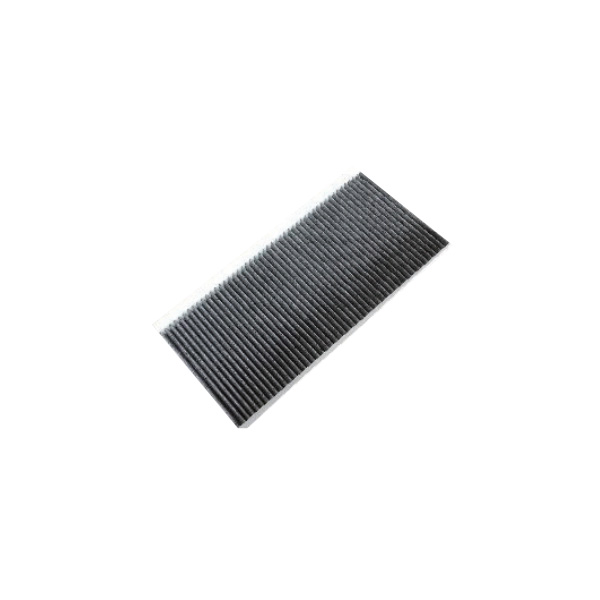
The Jyntrel antibacterial automotive cabin air filter is a dual-layer filter combining high-efficiency HEPA media and high-iodine coconut shell activated carbon. It captures PM2.5 particles and dust while adsorbing ammonia, sulfides, and exhaust VOCs from the air entering the vehicle cabin. It is designed for passenger cars, buses, heavy trucks, and construction machinery, and is available as an OEM/ODM solution for any vehicle model.
In a vehicle HVAC system, the cabin filter sits in the fresh-air and recirculation path, where airflow rate and face velocity vary with blower speed and driving conditions. Jyntrel's filter is engineered for low resistance: the pleated structure maintains a large effective filtration area, so pressure drop stays low even at high blower settings. This helps preserve HVAC airflow and reduces load on the blower motor.
The filter performs reliably across typical cabin temperatures and humidity levels. The activated carbon layer targets odours and gases, while the HEPA layer captures fine particles. For heavy-traffic or dusty environments, the high dust-holding capacity extends service life. If you operate in extreme conditions—such as high humidity, coastal salt air, or heavy pollution—share your data so we can recommend the appropriate media grade and pleat count.
The filter's core performance comes from its two functional layers. The HEPA layer provides high-efficiency particle capture, targeting PM2.5 and allergens. The coconut shell activated carbon has a high iodine value, giving it strong adsorption capacity for ammonia, sulfur compounds, and VOCs from exhaust fumes. Together, they improve cabin air quality for passengers.
Antibacterial treatment on the filter inhibits the growth of common bacteria such as E. coli and Staphylococcus aureus, with an antibacterial rate of over 99% in laboratory tests. This helps keep the filter and the HVAC system cleaner between replacements. The pleated design also delivers low initial resistance and high dust-holding capacity, supporting longer service intervals and consistent airflow.
Jyntrel offers full OEM/ODM customisation for cabin filters. To recommend the right specification, we need the following information:
With these details, our engineering team can propose a filter configuration that balances efficiency, resistance, and service life. We can also provide samples for validation.
| Item | Detail |
|---|---|
| Product name | Automotive Cabin Air Filter (Antibacterial) |
| Core structure | Dual-layer composite: high-efficiency HEPA media + high-iodine coconut shell granular activated carbon |
| Filtration performance | High-efficiency capture of PM2.5 particles and dust; deep adsorption of ammonia, sulfides, and exhaust VOCs |
| Airflow characteristics | Low operating resistance, high dust-holding capacity, long service life |
| Applications | Passenger cars (sedans, SUVs, MPVs), commercial buses, heavy trucks, and construction machinery HVAC systems |
| Customisation | 100% OEM/ODM for all vehicle models; custom length, width, thickness, and pleat count to match original air duct requirements |
| Quality certification | Manufactured in a 50,000 m² plant under IATF 16949 automotive quality management system; tested by a CNAS-accredited laboratory |
Jyntrel cabin air filters are used in a wide range of vehicles:
The filters are compatible with many vehicle brands, including BMW, Mercedes-Benz, Toyota, Honda, Volkswagen, and Tesla. Custom solutions are available for any model.
Jyntrel has over 20 years of experience in filtration product development and manufacturing, with products exported to Europe, the US, Japan, and South Korea for more than two decades. Our 50,000 m² production facility includes six cleanrooms totalling 20,000 m², ensuring a contamination-free production environment. Multiple automated production lines deliver a monthly capacity of millions of pieces, supporting stable supply for large orders.
Quality is managed through IQC, IPQC, and OQC processes. Our CNAS-accredited laboratory can issue test reports for filtration efficiency, dust-holding capacity, and resistance. We are certified to IATF 16949 (2024), ISO 9001, ISO 14001, and ISO 45001, and our products comply with REACH and RoHS regulations. With over 1,000 filtration solutions developed, we can tailor a cabin filter to your exact requirements.
To receive a tailored solution, please provide the following details through our contact page:
Our team will respond with a recommendation and quotation promptly.
Yes. The pleated design provides a large filtration area, keeping pressure drop low even at high blower speeds. This helps maintain HVAC airflow and reduces strain on the blower motor. For specific velocity data, please share your airflow requirements.
We need the airflow rate (m³/h) or blower specifications, along with the filter dimensions and expected operating conditions. This allows us to estimate face velocity and recommend the appropriate media and pleat count. If you have a target pressure drop, please include that as well.
The HEPA layer provides high-efficiency capture of PM2.5 particles and dust. The antibacterial treatment inhibits common bacteria such as E. coli and Staphylococcus aureus with an antibacterial rate of over 99% in laboratory tests. Test reports from our CNAS-accredited laboratory are available upon request.
Yes. We support full OEM/ODM customisation, including dimensions, pleat count, media grade, frame material, and packaging. Provide your vehicle model and dimensions or a drawing, and we will develop a filter to match. We have experience with a wide range of models, including BMW, Mercedes-Benz, Toyota, Honda, Volkswagen, and Tesla.
For standard models, the MOQ is typically 500–1,000 pieces. Custom models usually require 2,000–5,000 pieces, depending on tooling and materials. Lead time is 15–25 days for standard products, 30–45 days for custom development (including tooling), and 25–35 days for mass production. Our monthly capacity of millions of pieces supports large orders.
Under normal driving conditions, we recommend replacement every 15,000–20,000 km or once a year. In heavily polluted or dusty areas, shorten the interval to 10,000 km. Our CNAS laboratory can provide life testing data to support your maintenance schedule.
Yes. We provide samples for evaluation. Standard stock samples ship within 3–5 working days; custom samples typically take 7–15 working days. Samples include CNAS laboratory test reports covering filtration efficiency, antibacterial rate, resistance, and dust-holding capacity.
High pollution levels, frequent stop-and-go traffic, and dusty environments accelerate filter loading and shorten service life. High humidity can also affect activated carbon performance. By sharing your operating conditions, we can recommend a filter configuration that balances efficiency and replacement interval.