
Richiedi una soluzione
IT-IT▼
Questo prodotto è compatibile con le apparecchiature e le applicazioni dei seguenti marchi o adatto alle stesse, solo come riferimento per la scelta. I marchi appartengono ai rispettivi proprietari; non implicano affiliazione o approvazione.
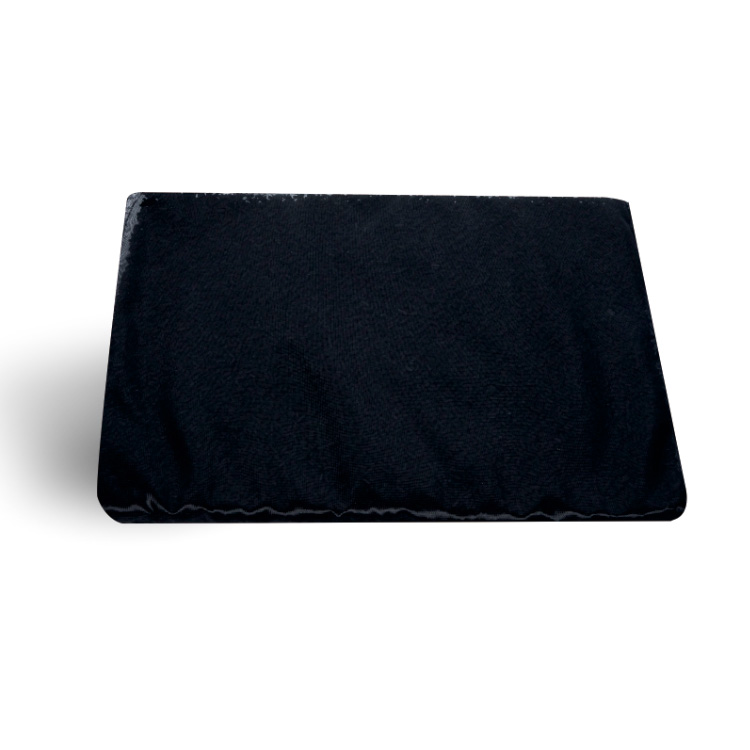
Jyntrel adhesive carbon filter mesh is a bonded activated carbon filter in which high-iodine-value carbon granules are fixed onto an environmentally friendly substrate, so the carbon stays in place across the face of the filter. It is built to remove formaldehyde (HCHO), benzene, ammonia and other volatile organic compounds (VOCs) and odours from the air passing through it. It suits appliance and equipment designers — air purifiers, fresh-air systems, range hoods, vehicle and central air conditioning, vacuum cleaners and similar air paths — who need a thin, low-resistance carbon stage matched to their housing. The brand is Jyntrel, manufactured in Zhongshan, Guangdong, China.
In an air path, a carbon stage is judged by how it behaves at the velocity and duty cycle the system actually delivers. Bonded carbon granules form a distributed adsorption layer across the substrate, so the air stream meets carbon over the full open face rather than at a few fixed points. This keeps the pressure drop low relative to the carbon mass carried, which matters where the fan is small or where the filter sits downstream of a primary stage.
Three conditions shape the result: the contaminant concentration at the filter face, the airflow and resulting face velocity, and how long the filter stays in service. A domestic purifier running eight hours a day sees a very different loading profile from a commercial ventilation system running continuously, and a range hood sees grease and oil mist that a bedroom purifier never does. Because sizing is custom, thickness, carbon weight per unit area and face area can be set so that residence time and resistance both sit inside the fan curve you have. Where the target is a specific gas rather than general odour, the carbon type can be matched to it.
The performance target for this product is adsorption of HCHO, benzene, ammonia, VOCs and odours. Because the carbon is bonded rather than loose-filled, granules remain evenly distributed during handling, installation and airflow, which supports consistent behaviour from the first hour to the end of the service interval.
The adhesive carbon process also allows the carbon layer to be combined with other filter media in one part, which is useful where a single slot in the housing must carry both particle and gas duties.
Selection starts with the air path, not with a catalogue size. To propose a construction we ask for the device or vehicle model, the space available and any drawing or 3D file, the airflow the fan delivers through that slot, and the operating conditions: temperature, humidity, contaminant or odour source and expected run hours. Quantity and target service life complete the picture.
From these inputs we can vary the dimensions, shape, frame material, carbon loading and carbon type, and add logo and packaging customisation under OEM/ODM. Jyntrel has developed more than 1,000 filter solutions, and that library is the starting point for matching a new air path rather than beginning from zero.
| Item | Detail |
|---|---|
| Filter material | High-quality, high-iodine-value activated carbon granules on an environmentally friendly substrate, adhesive carbon process |
| Dimensions | Made to order; various sizes, shapes and frame materials supported |
| Core performance | Effective removal of formaldehyde (HCHO), benzene, ammonia and other VOCs, plus odours |
| Applications | Domestic and commercial air purifiers, fresh-air systems, vehicle air conditioning filters, central air conditioning, vacuum cleaner filters and similar |
| Manufacturer | Zhongshan company filtration products plant, Zhongshan, Guangdong, China |
The same bonded carbon construction serves several air paths with different priorities. In domestic and commercial air purifiers and fresh-air systems the goal is general VOC and odour reduction at low resistance. In vehicle air conditioning and cabin filtration, compact size and stable carbon retention matter. In range hoods and integrated stoves, the filter faces oil smoke and grease, so the construction is specified for that environment. Vacuum cleaner filters, central air conditioning and commercial ventilation use the same principle at larger face areas. The material is also used for ozone removal and TVOC removal stages, and in cat litter box odour filters, where a small, thin carbon part is the whole requirement.
Supply stability comes first. Multiple automated production lines give monthly capacity in the millions of pieces, and more than 20 years of continuous export to Europe, the United States, Japan and South Korea means the documentation and packaging expectations of those markets are routine. The plant covers 50,000 m², including six clean workshops totalling 20,000 m².
Testing is handled by our own laboratory, which is CNAS-accredited and can issue reports on filtration efficiency, dust holding capacity and resistance. Quality control runs through IQC, IPQC and OQC. The company holds ISO 9001, ISO 14001 and ISO 45001 certification and has been certified to IATF 16949 for automotive quality management since 2024. Products meet REACH and RoHS requirements, with compliance documents available on request.
Send the device or vehicle model, the available size or a drawing, the airflow through the filter slot, the operating conditions and your quantity, and we will propose a construction and quote against it. If the target is a specific gas, say which one. Contact our team to start.
The bonded carbon layer is designed for low resistance, but high face velocity shortens the contact time between air and carbon. For fast air paths we adjust carbon loading and face area so residence time stays workable. Share the airflow and slot dimensions and we will size it.
We need the airflow the fan delivers through the filter position, the face area or slot dimensions, and the expected run hours. Contaminant type and concentration help us choose the carbon. A drawing or 3D file of the housing speeds up the proposal.
Yes. Dimensions, shape and frame material are made to order, so the filter is built to your housing rather than adapted afterwards. Send the model and drawing, and we will confirm a feasible construction. OEM/ODM customisation including logo and packaging is supported.
Yes. Sample and quotation policy follows the project; tell us the target size, airflow and quantity so we can quote accurately. Samples are the normal route before a production order, and we can discuss what testing data you need alongside them.
Minimum order quantity is set per product and project rather than as one fixed figure. It depends on size, carbon specification and whether tooling or new construction is involved. Give us the model and annual volume and we will state the MOQ in the quotation.
Lead time depends on whether the construction is existing or new, and on order quantity. Because capacity runs in the millions of pieces per month across multiple automated lines, volume orders are scheduled within that capacity. We confirm dates in the quotation.
Replacement depends on contaminant concentration and run hours, so there is no single interval. A domestic appliance on short daily use lasts longer than a commercial system running continuously. We can assess expected life against your operating conditions during selection.
Send the device or vehicle model, size or drawing, airflow, operating conditions and quantity through our contact page. If a specific gas is the target, name it. We will reply with a proposed construction and quotation.