
Richiedi una soluzione
IT-IT▼
Questo prodotto è compatibile con le apparecchiature e le applicazioni dei seguenti marchi o adatto alle stesse, solo come riferimento per la scelta. I marchi appartengono ai rispettivi proprietari; non implicano affiliazione o approvazione.
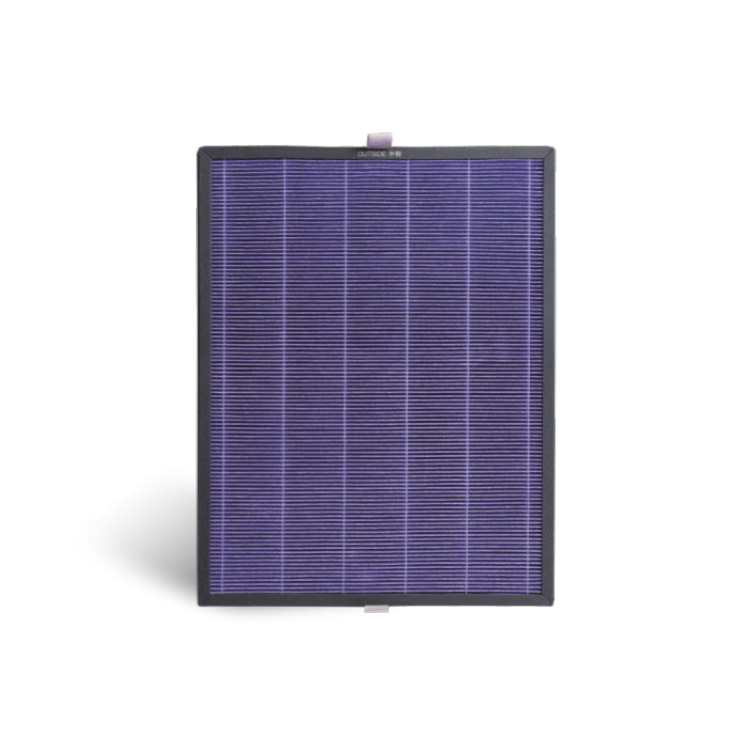
Jyntrel's flat panel HEPA activated carbon composite filter is a thin, dual-layer panel that removes fine particles and odours in one pass through the air path. The HEPA layer captures particulate matter and the activated carbon layer adsorbs formaldehyde, TVOC and odour, making it a fit for household and commercial air purifiers, desktop mini purifiers, humidifier-purifier units and dehumidifiers. It is built for OEM integration, where the panel thickness, face dimensions and frame sealing are matched to the appliance cavity and to the airflow the fan can deliver.
In a compact purifier, the filter sits close to the fan and the available static pressure is limited. A thick, dense element raises resistance and pulls airflow down, so the cabinet may recirculate less air than intended. The flat panel design addresses this by keeping the panel thin and the face area large, so air passes through at low resistance while the appliance keeps its intended airflow and the housing keeps its slim profile.
Two conditions shape the selection. The first is face velocity: a small face area at a given airflow means higher velocity through the media, and the media must be chosen to hold efficiency and pressure drop at that velocity. The second is the duty pattern: continuous operation in a bedroom or intermittent use in a bathroom changes dust loading and the carbon layer's service life. Both are measurable, and both should be settled before tooling.
The carbon stage behaves differently from the HEPA stage. Particulate loading builds gradually and shows up as rising pressure drop, while odour breakthrough depends on the contaminant concentration and the total volume of air processed. In a humid environment such as a combined humidifier-purifier, the carbon should be protected by the panel's structure and the operating data should state the humidity range.
Particle capture is delivered by PP (polypropylene), PP+PET composite or PTFE media. The carbon layer uses quality honeycomb activated carbon or modified aldehyde-removal carbon granules. Efficiency grade and CADR are set by the selected media together with the customer's fan parameters; they are not fixed in advance, because the same media behaves differently at different airflows. Jyntrel confirms the combination against the appliance data rather than quoting a figure out of context.
Commonly specified media support H13-grade performance at 0.3 µm, with H14 available on request. The carbon layer targets formaldehyde, TVOC and odour. The composite therefore handles particles and gases in a single panel, which matters in appliances where two separate filter slots are not available.
The flat structure is the defining trait: low resistance and high use of the space inside the housing. It allows designers to reduce cabinet depth without giving up filter face area, and it suits equipment that runs at modest static pressure. Frame and sealing are made to the customer's cavity, so the panel seats without bypass around the edges.
Customisation is complete: length, width and thickness are made to the appliance cavity, and the frame and sealing are handled to specification. What we need from you is a short set of operating parameters:
With these inputs, media grade and carbon loading are selected so that efficiency, resistance and service life line up with the appliance rather than against it.
| Item | Detail |
|---|---|
| Product name | Flat Panel HEPA & Carbon Composite Filter |
| Physical structure | MAX flat design; low air resistance; high use of available space |
| Particle media | PP (polypropylene) / PP+PET composite / PTFE |
| Odour media | Quality honeycomb activated carbon / modified aldehyde-removal carbon granules |
| Filtration performance | Efficiency grade and CADR value depend on the selected media and the customer's fan parameters |
| Main end uses | Household and commercial air purifiers, desktop mini purifiers, humidifier-purifier units, dehumidifiers |
| Size and specification | 100% OEM customisation; any length, width and thickness to the customer's appliance cavity, with frame and sealing treatment |
| Quality system | ISO 9001 / 14001 and IATF 16949 certified; CNAS-accredited testing centre; resistance, efficiency and odour-decay indicators controlled at dispatch |
The panel is used where space is tight and both particles and odours must be handled. That includes household and commercial air purifiers, desktop mini purifiers, combined humidifier-purifiers and dehumidifiers. In each case the panel is treated as part of the air path: the appliance fan, the cavity depth and the expected contaminant load determine the media grade and carbon charge.
In a mini purifier, the low profile lets the product stay compact without sacrificing face area. In a dehumidifier or humidifier-purifier, the composite handles dust and odour while the appliance manages moisture. When the same platform is sold in several markets, one panel design can be produced to different efficiency grades if the fan and housing allow.
Jyntrel operates multiple automated production lines with monthly capacity in the millions of pieces, and has exported filtration products to Europe, the United States, Japan and Korea for more than 20 years, which supports stable supply across long programmes. Production runs in a 50,000 m² plant in Zhongshan, Guangdong, including 6 clean rooms totalling 20,000 m².
An in-house laboratory accredited by CNAS issues test reports on filtration efficiency, dust holding capacity and resistance, and outgoing batches are controlled for resistance, efficiency and odour-decay indicators. The company holds ISO 9001, ISO 14001 and ISO 45001, and has held IATF 16949 since 2024. Products comply with REACH and RoHS, and compliance documents can be supplied. Quality control runs through IQC, IPQC and OQC.
Send the device or vehicle model, the cavity size or a drawing, the rated airflow or water flow, the operating conditions and your quantity. Our team will propose a media and carbon combination and confirm the specification against your fan curve. Start at our contact page.
The panel uses a dual-layer composite: a HEPA layer on PP, PP+PET or PTFE media, commonly specified at H13-grade performance for 0.3 µm particles and upgradeable to H14, plus a carbon layer of honeycomb activated carbon or modified aldehyde-removal carbon granules for formaldehyde, TVOC and odour. Efficiency grade and CADR are confirmed against the selected media and your fan parameters, so the quoted figure reflects your appliance rather than a standalone sample.
The flat design keeps resistance low relative to face area, which helps where cabinet depth is limited. Velocity still matters: at a given airflow, a smaller face area raises velocity through the media, so media grade and carbon loading are chosen for your airflow and available static pressure. Share the rated airflow and we will confirm the combination that holds efficiency within your pressure-drop limit.
We need the rated airflow, the fan's available static pressure, the target efficiency grade or CADR, the contaminants to control, and the operating temperature and humidity. A drawing or sample of the filter cavity, the required service interval and the quantity complete the picture. From these we select the media and carbon charge and state the expected resistance.
Yes. Sizes are 100% OEM customised: length, width and thickness are made to your appliance cavity, and frame and sealing are produced to your specification. Desktop purifiers, humidifier-purifiers and dehumidifiers each impose different depth and sealing needs, so we work from your drawing or sample. Logo and packaging can also be customised.
Samples can be supplied for performance testing and market validation. Minimum order quantity, lead time and sample policy are confirmed for this product when the specification is fixed, since a custom flat panel differs from a standard size. Send your cavity data and expected quantity and we will quote the MOQ and schedule with the proposal.
Lead time depends on the panel structure, media and quantity, and is confirmed in the quotation once the specification is agreed. Multiple automated lines with monthly capacity in the millions of pieces support repeat orders and seasonal build-ups. For planning, tell us your launch date and annual volume together with the technical data.
Replacement depends on the contaminant load, daily running hours and the humidity of the application. The particle stage signals its end through rising resistance, while the carbon stage reaches odour breakthrough after a certain volume of air has been processed. Give us the duty pattern and target service interval, and we will select media and carbon loading to suit it.
Send the device model, cavity size or drawing, rated airflow, operating conditions and quantity through <a href="/en/contact">our contact page</a>. Our engineers will return a proposed media and carbon combination with the specification for your review.</p>