솔루션 받기
KO-KR▼
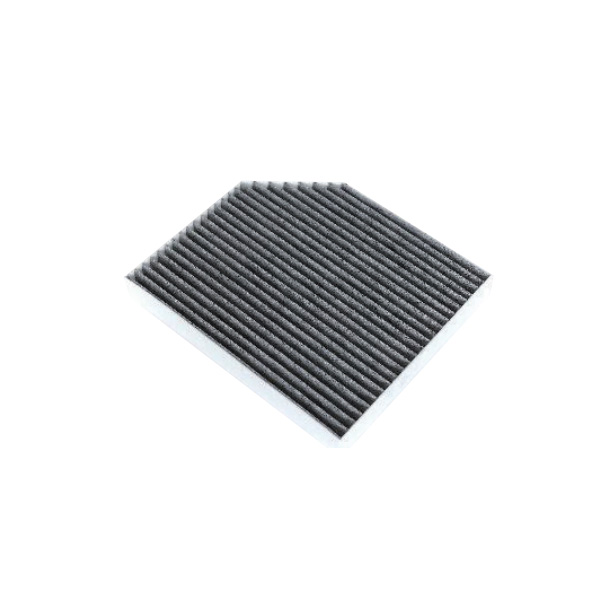
The Jyntrel automotive cabin air filter is a dual-layer filtration component that combines high-efficiency HEPA media with high-iodine coconut-shell granular activated carbon. It captures PM2.5 particulate matter, dust, and pollen while adsorbing ammonia, sulfur compounds, and exhaust VOCs from the air entering the vehicle cabin. This filter is designed for passenger cars, SUVs, MPVs, commercial buses, heavy trucks, and construction machinery, and is available through full OEM/ODM customisation for any vehicle model.
The cabin air filter sits within the HVAC air path, upstream of the blower or evaporator depending on the vehicle architecture. Air velocity at the filter face varies with blower speed and system design, and the filter must maintain low resistance across the full operating range to avoid reducing airflow at the vents. Jyntrel's pleated construction is engineered for low initial pressure drop, so the air-handling performance of the air conditioning system remains stable even at higher blower settings.
Operating conditions also include the external environment: traffic exhaust, road dust, pollen seasons, and humidity. The activated carbon layer is intended to adsorb odour-causing gases and VOCs, while the HEPA layer captures fine particles. Because the filter is exposed to varying dust loading over time, high dust-holding capacity extends service life and helps maintain airflow between replacement intervals.
The filter's performance is defined by two functions working in series: particle removal and gas adsorption. The HEPA layer is rated for high-efficiency capture of PM2.5 and dust, supporting cleaner cabin air for occupants. The coconut-shell activated carbon is selected for high iodine value, which relates to its adsorption capacity for ammonia, sulfur compounds, and exhaust VOCs.
From a fluid-dynamics perspective, the pleat geometry and media selection are balanced to keep resistance low while providing a high dust-holding capacity. This means the filter can operate across a range of airflow rates without imposing excessive load on the blower. For HVAC engineers, the key selection criteria are the vehicle's airflow demand, the available installation space, and the target filtration efficiency. Jyntrel supplies filters in multiple media grades and pleat counts to match these requirements.
Because cabin air filters are vehicle-specific, selection starts with the installation envelope. Jyntrel supports 100% OEM/ODM customisation for all vehicle models: length, width, thickness, and pleat count can be tailored to the original HVAC duct requirements. To recommend or develop a filter, we need the following information:
With this data, our engineering team can propose a media grade and pleat design, and develop samples for validation. Custom samples are typically developed within 7–10 working days after drawing confirmation.
| Item | Detail |
|---|---|
| Product name | Automotive Cabin Air Filter |
| Core structure | Dual-layer composite: high-efficiency HEPA media + high-iodine coconut-shell granular activated carbon |
| Core purification performance | High-efficiency capture of PM2.5 particulate matter and dust; targeted adsorption of ammonia, sulfur compounds, and exhaust VOCs |
| Physical flow characteristics | Good airflow characteristics, low operating resistance, high dust-holding capacity and service life |
| Main applications | Passenger cars (sedans, SUVs, MPVs, etc.), commercial buses, heavy trucks, and construction machinery HVAC systems |
| Customisation | 100% OEM/ODM customisation for all vehicle models; custom length, width, thickness, and pleat count according to original HVAC duct requirements |
| Quality certification | Manufactured in a 50,000 m² plant under IATF 16949 automotive quality management system; factory quality assurance by a CNAS-accredited testing centre |
This filter is used in the air conditioning and ventilation systems of passenger cars, commercial buses, heavy trucks, and construction machinery. In passenger vehicles, it protects occupants from traffic exhaust, road dust, and pollen. In commercial fleets and heavy equipment, where dust loads can be higher and operating hours longer, the high dust-holding capacity and low resistance help maintain HVAC performance. The activated carbon layer is particularly relevant in urban traffic and tunnels, where exhaust odours and VOCs are present.
Because the filter is available in custom sizes and media grades, it can be specified for original equipment programs as well as aftermarket replacement. Typical media options include standard dust removal, PM2.5 high-efficiency, activated carbon composite, and HEPA grades, with frame materials such as paper, plastic, or metal.
Jyntrel has more than 20 years of experience in filtration product development and manufacturing, with continuous exports to Europe, the United States, Japan, and South Korea for over 20 years. This export history supports supply stability and familiarity with international compliance requirements. Production takes place in a 50,000 m² plant that includes six clean workshops totalling 20,000 m², with multiple automated production lines capable of millions of pieces per month.
Quality is managed through IQC, IPQC, and OQC processes. The company's in-house laboratory is CNAS-accredited and can issue test reports for filtration efficiency, dust-holding capacity, and resistance. Jyntrel obtained IATF 16949 certification in 2024 and holds ISO 9001, ISO 14001, and ISO 45001 certifications. Products comply with REACH and RoHS environmental regulations, and compliance documentation can be provided. The company is located in Zhongshan, Guangdong, China.
To receive a tailored recommendation, please provide the vehicle or device model, the filter size or a drawing, the airflow or blower data, the operating conditions (dust load, humidity, odour concerns), and the estimated quantity. Our team will respond with a suitable configuration and quotation. Contact us to start the conversation.
Yes. The pleated design is engineered for low operating resistance, so it maintains airflow across a range of blower speeds. At higher velocities, the pressure drop remains within the system's capacity, helping to preserve HVAC performance. For specific airflow data, please share your system parameters with our engineers.
We need the vehicle model and year, the filter's dimensions or a drawing, and the HVAC blower's airflow or static pressure curve if available. This allows us to select the appropriate media grade and pleat count. If you do not have airflow data, we can work from the original filter sample or part number.
The HEPA layer provides high-efficiency capture of PM2.5 and dust, while the activated carbon adsorbs ammonia, sulfur compounds, and VOCs. Efficiency is validated by our CNAS-accredited laboratory, and test reports can be provided with shipments. For application-specific efficiency targets, please contact us with your requirements.
Yes. We support 100% OEM/ODM customisation for all vehicle models, including length, width, thickness, and pleat count. Custom samples are typically developed within 7–10 working days after drawing confirmation. Please provide a dimensioned drawing or sample to begin.
Standard specifications typically have an MOQ of 1,000–2,000 pieces, while customised versions generally start at 5,000 pieces depending on tooling. Free samples are available for standard items (freight collect); custom samples incur a small development fee, which can be credited against the first order. We encourage sample validation before mass production.
Standard products ship in 15–25 days, and customised products in 30–45 days including tooling. With multiple automated lines and a monthly capacity of millions of pieces, we can support large fleet and OEM programs. Lead times are confirmed at order placement.
Under normal driving conditions, we recommend replacement every 10,000–15,000 km or 6–12 months, whichever comes first. In dusty or heavily polluted environments, shorten the interval. The filter's high dust-holding capacity helps maintain performance between changes.
Yes. Jyntrel is IATF 16949 certified (2024) and holds ISO 9001, ISO 14001, and ISO 45001 certifications. Products comply with REACH and RoHS, and our CNAS-accredited lab provides test reports. Please contact us for compliance documentation.