
솔루션 받기
KO-KR▼
본 제품은 아래 브랜드의 장비 및 응용 분야와 호환되거나 이에 적합하며, 선정 시 참고용으로만 제공됩니다. 상표는 각 소유자에게 귀속되며 파트너십이나 보증을 의미하지 않습니다.
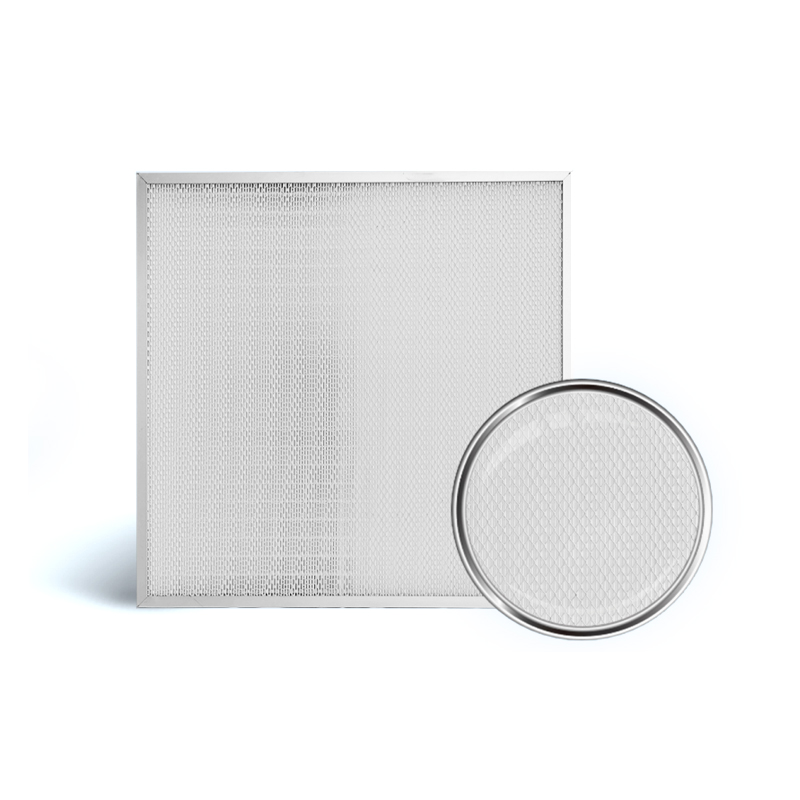
The Jyntrel panel high-efficiency filter is a rigid, pleated filter element used as the final stage in cleanroom, FFU, laminar-flow and commercial HVAC air paths. It captures fine particulate down to 0.3 μm, with H13 and H14 grades available and efficiencies up to 99.99% and above on some models, and selected versions reach ULPA U15/U16 level. It is intended for semiconductor and microelectronics fabs, pharmaceutical and food processing cleanrooms, hospital operating suites, data centres and other spaces where the air path must hold a defined cleanliness class. Jyntrel builds it in Zhongshan, Guangdong, China, with the frame, media and seal configured to the duty point rather than sold as a single fixed size.
Place the filter where the design velocity, face area and resistance budget have already been settled, not the reverse. In a cleanroom or FFU terminal, the panel sits at the end of the supply path after pre-filtration, so the air reaching it carries a reduced dust load; in a commercial HVAC system it may serve as the final stage behind coarser filters, and the pre-filter choice affects how quickly the terminal element loads. The pleat pack gives a large media area within a shallow frame, which keeps face velocity low enough to limit re-entrainment and to hold pressure drop within the fan curve of the air handler or FFU.
Think in terms of the whole path: upstream pre-filters set the dust load, the panel sets the final efficiency, and downstream ductwork or diffusers set the distribution. If the terminal filter is sized only on face dimensions without checking the resistance at the design airflow, the fan may run outside its efficient band. Jyntrel therefore asks for the design airflow, the permitted initial and final resistance, and the cleanliness class or particle size to be controlled before recommending a grade and pleat configuration.
Efficiency is the first design variable. The range covers H13 and H14 grades, with filtration efficiency of 99.99% and above on 0.3 μm particles for the higher grades, and some models reach ULPA U15/U16. The correct grade follows from the target cleanliness class and the particle size that matters in the process, not from a general preference for the highest number. In semiconductor wafer fabrication, lithography rooms, chip packaging and microelectronics assembly, the panel is used in ISO Class 1–7 cleanrooms and as the terminal filter in FFU fan-filter units, clean transfer windows and laminar-flow hoods.
Resistance and service life are the second variable. A panel holds its efficiency while resistance rises with dust loading; the replacement point is normally when the final resistance reaches twice the initial resistance or the design final resistance, whichever the project specifies. Service life is typically 1–3 years depending on the cleanliness of the surrounding air, the operating velocity, the pre-filter arrangement and daily running hours. A well-matched pre-filter stage extends terminal filter life and lowers the overall cost of running the air path.
This is a configured product rather than a catalogue-only item. Jyntrel customises dimensions (length, width, height and depth), frame material (aluminium alloy, galvanised steel, stainless steel, MDF or plastic), filter media (glass fibre, PTFE and others), sealant type and separators (hot-melt adhesive, aluminium foil or paper). OEM and ODM service covers the full route from drawing review and sample validation to series production, supported by an engineering team and more than 1,000 filtration solutions developed to date.
To quote accurately, send the device or vehicle model where the filter is used, the size or a drawing, the design airflow or water flow, the operating conditions (temperature, humidity, dust load, upstream pre-filters, permitted initial and final resistance), the required efficiency grade and the quantity. With those inputs Jyntrel can propose a frame, media and pleat arrangement and confirm the duty point on a sample before volume supply.
| Item | Detail |
|---|---|
| Product name | Panel high-efficiency filter |
| Brand | Jyntrel |
| Product category | High-efficiency filter |
| Filter type | Rigid pleated panel filter for terminal and final-stage air filtration |
| Efficiency grades | H13, H14; selected models ULPA U15/U16 |
| Particle retention | Up to 99.99% and above on 0.3 μm particles (higher grades) |
| Typical cleanliness classes | ISO Class 1–7 cleanrooms |
| Frame material | Aluminium alloy, galvanised steel, stainless steel, MDF or plastic — to order |
| Filter media | Glass fibre, PTFE and other options — to order |
| Separators | Hot-melt adhesive, aluminium foil or paper — to order |
| Dimensions | Custom length, width, height and depth to drawing or duty point |
| Sealant | Selected according to operating conditions |
| Replacement point | When final resistance reaches twice the initial resistance or the design final resistance |
| Typical service life | 1–3 years, depending on air cleanliness, velocity, pre-filtration and running hours |
| Customisation | OEM/ODM: size, frame, media, separator, logo and packaging |
| Origin | Zhongshan, Guangdong, China |
The panel filter appears wherever a defined cleanliness class or a controlled final stage is required at the end of an air path. In semiconductor and microelectronics manufacturing it serves wafer fabrication, lithography areas, chip packaging and microelectronics assembly, and it is built into FFU fan-filter units, clean transfer windows and laminar-flow hoods. In healthcare and cleanroom work it is used in operating suites, cleanrooms and controlled production rooms. Pharmaceutical and food processing plants use it where air quality forms part of the process control.
Other duties include commercial air-conditioning and ventilation systems as a final stage, data centres and AI computing facilities where heat density and air quality both matter, energy and metal-smelting environments, automotive and machinery manufacturing, and energy-storage production areas. In each case the grade, frame and pleat arrangement follow the cleanliness target and the resistance budget of the system, not a single default specification.
Supply stability starts with capacity. Jyntrel runs multiple automated production lines with monthly output reaching millions of pieces, and has exported to Europe, the United States, Japan and South Korea for more than 20 years. The plant covers 50,000 m², including six cleanrooms totalling 20,000 m² in which the panel filters are assembled in a controlled environment to avoid cross-contamination. Quality control runs through IQC, IPQC, FQC and OQC, so incoming material, in-process work and finished goods are each checked before release.
Testing is carried out in the company's own laboratory, which is accredited by CNAS and can issue reports on filtration efficiency, dust-holding capacity and resistance. Each high-efficiency filter is tested for efficiency, scanned for leaks with PAO/DOP and checked for resistance before it leaves the plant. The management system holds ISO 9001, ISO 14001 and ISO 45001 certification, and IATF 16949 was added in 2024. Products meet the REACH and RoHS environmental requirements, and compliance documents can be supplied on request.
To move from a requirement to a quotation, send the device or vehicle model, the size or drawing, the design airflow or water flow, the operating conditions and the annual quantity. Jyntrel will match the grade, frame and pleat arrangement to your air path and confirm the specification on a sample before series supply. Start at the contact page and include the data above so the engineering team can respond with a concrete proposal.
The pleat pack spreads the airflow over a large media area, which keeps face velocity low enough to hold efficiency and stay within the resistance budget of the fan or FFU. The acceptable velocity depends on the grade, pleat depth and permitted final resistance, so share the design airflow and the resistance limits and Jyntrel will confirm the configuration.
Provide the design airflow, the permitted initial and final resistance, the particle size or cleanliness class to be controlled, and the space available for the frame. The device or vehicle model and a drawing help confirm the interface. With these figures Jyntrel can propose a grade, frame material and pleat arrangement and state the expected duty point.
Grades H13 and H14 are available, with efficiency of 99.99% and above on 0.3 μm particles for the higher grades, and selected models reach ULPA U15/U16. The right grade follows from the target ISO class and the particle size that matters in the process. The CNAS-accredited laboratory can issue efficiency, resistance and dust-holding reports.
Yes. Dimensions, frame material (aluminium alloy, galvanised steel, stainless steel, MDF or plastic), media (glass fibre, PTFE and others), sealant and separators can all be specified. OEM and ODM service covers drawing review, sample validation and series production, with more than 1,000 filtration solutions developed to date. Send a drawing or the device model to start the review.
For standard sizes the MOQ is generally 50–100 pieces; customised sizes depend on structural complexity and usually start at 100–200 pieces, with flexibility for new customers and sample orders. Standard items ship in 7–15 days, while custom orders typically take 25–35 days for volume production. Automated lines and stocked raw materials support urgent and long-term supply.
Typical service life is 1–3 years, depending on air cleanliness, operating velocity, the upstream pre-filter arrangement and daily running hours. The usual replacement point is when final resistance reaches twice the initial resistance or the design final resistance. A well-matched pre-filter stage extends terminal filter life and reduces overall running cost.
Each high-efficiency filter is tested for efficiency, scanned for leaks with PAO/DOP and checked for resistance in the company's CNAS-accredited laboratory before dispatch. Production runs through IQC, IPQC, FQC and OQC checks, and assembly takes place in cleanrooms to limit contamination. Reports on efficiency, dust-holding capacity and resistance can be provided.
Jyntrel holds ISO 9001, ISO 14001 and ISO 45001 certification, added IATF 16949 in 2024, and can provide REACH and RoHS compliance documents on request. Test reports from the CNAS-accredited laboratory cover efficiency, resistance and dust-holding capacity. Share the documentation list your qualification process requires and the team will confirm what can be supplied.