
Dapatkan Penyelesaian
MS-MY▼
Produk ini serasi dengan atau sesuai untuk peralatan dan aplikasi daripada jenama berikut, hanya sebagai rujukan pemilihan. Tanda dagangan dimiliki oleh pemilik masing-masing; tidak menunjukkan perkongsian atau sokongan.
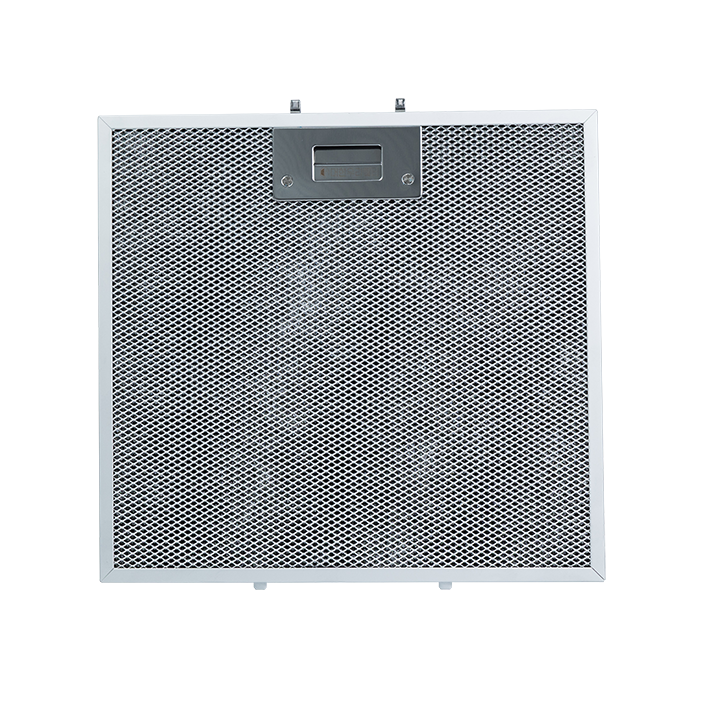
This is a European-style range hood filter from Jyntrel that combines an aluminium foil micro-perforated mesh with a flame-retardant polyester fibre layer and an activated carbon layer, so it captures heavy grease and adsorbs cooking odours in one part. It is designed for recirculating (ductless) cooker hoods, open-plan kitchens and commercial kitchen exhaust purification systems where air is returned to the room rather than sent outside. It suits appliance brands, OEM/ODM buyers and HVAC engineers who need a filter matched to a specific hood geometry and airflow path.
In a recirculating hood the filter sits at the end of the air path: grease-laden air leaves the cooking zone, passes the mesh, and is returned to the kitchen. That position sets the operating conditions the filter must survive. Air velocity at the filter face is usually highest directly above the hob, so the first layer — aluminium foil micro-perforated mesh — must hold its shape under continuous flow while knocking down heavy oil droplets before they reach the carbon.
The second consideration is temperature and humidity. Cooking air carries heat, steam and fine aerosolised fat. The flame-retardant polyester fibre layer behind the mesh works as a coalescing and odour-contact stage, while the high-quality granular or powdered activated carbon layer adsorbs cooking smells, including pungent and spicy notes that simple grease filters leave behind. Because the carbon is protected by the upstream layers, it is not quickly blinded by grease, which is what allows the odour stage to keep working across the service interval.
Ductless operation also means pressure drop matters. A filter that is too dense for the hood's fan curve will reduce airflow and let vapour escape at the hood edges. When we quote, we match layer count and mesh openness to the fan's available static pressure, so the filter removes oil and odour without stalling the air path.
The filter performs two jobs in one frame. The aluminium foil micro-perforated mesh separates and captures heavy grease; the activated carbon layer adsorbs cooking odours so that recirculated air does not carry smells back into the room. This dual action is the reason the part is used in internal-circulation hoods where there is no exhaust duct to carry vapour away.
Safety is addressed through flame retardancy: the construction conforms to UL 900 Class 1 / Class 2 fire safety testing certification. The outer frame is available in high-strength aluminium alloy profile or stainless steel edge, with optional clips and handles to suit the hood's mounting arrangement. Because the frame and layer stack are built to the customer's drawing, the filter can be sized to European top-draft and side-draft hoods as well as to commercial exhaust purification systems.
The part is also cleanable in service, which supports repeated removal and refitting in kitchens where maintenance access is limited. For odour performance, the carbon stage is the working life limiter rather than the mesh, so replacement planning should follow the carbon, not the visible grease loading alone.
Selection starts with the hood, not the filter. To propose a construction we need the hood model or a drawing showing the filter pocket, the face dimensions and thickness available, and the airflow the fan delivers at that point in the circuit. Operating conditions come next: whether the hood recirculates or exhausts, the cooking style and grease load, ambient temperature and humidity, and how often the kitchen can be taken out of service for cleaning or replacement.
From that data we set the aluminium layer count and mesh density, choose the polyester fibre and carbon layer, and define the frame profile, clips and handle. Jyntrel supports OEM/ODM flexible manufacturing, so dimensions, structure, logo and packaging can all be customised. Existing hood designs can usually be matched from a sample or a dimensioned drawing, and new programmes can be developed from a performance target.
| Item | Detail |
|---|---|
| Product name | European range hood filter (activated carbon odour-removal version) |
| Core materials | Aluminium foil micro-perforated mesh + flame-retardant polyester fibre + high-quality granular/powdered activated carbon layer |
| Main function | High-efficiency separation and capture of heavy grease; strong adsorption of cooking odours such as cooking fumes and pungent smells |
| Flame-retardant certification | Conforms to UL 900 Class 1 / Class 2 fire safety testing certification |
| Applications | Open-kitchen recirculating range hoods, commercial kitchen exhaust purification systems, European top-draft and side-draft range hoods |
| Outer frame options | High-strength aluminium alloy profile, stainless steel edge (optional clips and handles) |
| Customisation and capacity | OEM/ODM flexible manufacturing; company holds IATF 16949 / ISO 9001 systems; national-level CNAS testing centre supports batch quality |
Jyntrel runs multiple automated production lines with a monthly capacity of millions of pieces, which is what allows custom hood filter programmes to move from sample to volume without changing suppliers. The production base in Zhongshan, Guangdong, China covers a 50,000 m² plant, including six clean workshops totalling 20,000 m². Our own laboratory is CNAS-accredited and can issue test reports on filtration efficiency, dust holding capacity and resistance.
Quality management follows IATF 16949, obtained in 2024, alongside ISO 9001, ISO 14001 and ISO 45001. Products meet REACH and RoHS requirements and compliance documents can be supplied. With more than 20 years of filtration development and manufacturing experience and over 20 years of continuous export to Europe, the United States, Japan and South Korea, we hold more than 1,000 developed filtration solutions. IQC, IPQC and OQC checks run through the whole process.
Send us the device or vehicle model, the filter size or a drawing, the airflow or water flow at the filter, the operating conditions (recirculating or ducted, temperature, grease load, cleaning cycle) and the quantity you plan to order. With those inputs we can propose a layer stack, frame and carbon loading, and return a quotation for samples and volume. Start here: contact our team.
The aluminium foil micro-perforated mesh is the first stage and is built to hold its shape under continuous flow, capturing heavy oil droplets before they reach the carbon. At high face velocity the layer count and mesh openness should be matched to the hood's fan curve so pressure drop does not reduce airflow. Share the airflow and filter face dimensions and we will propose a construction.
We need the airflow the fan delivers at the filter position, the face dimensions and available thickness, and whether the hood recirculates or exhausts. Cooking style, grease load, temperature and humidity help us set the carbon layer and service interval. A hood model or dimensioned drawing is the fastest starting point.
The aluminium mesh stage separates and captures heavy grease, while the activated carbon layer adsorbs cooking odours such as fumes and pungent smells. Efficiency depends on layer count, mesh density and the airflow through the filter, so we test the proposed construction in our CNAS-accredited laboratory and report filtration efficiency, dust holding capacity and resistance.
Yes. Dimensions, aluminium layer count, mesh density, handle style, frame profile and surface treatment can all be built to your drawing or sample. The high-strength aluminium alloy profile or stainless steel edge can include clips and handles to suit the hood. Jyntrel supports OEM/ODM flexible manufacturing and can also help optimise the structure before sampling.
Standard models typically start at 500–1,000 pieces; customised models are generally 2,000–3,000 pieces, negotiable with the order. Samples are usually available within 3–7 days, and volume orders typically ship in 25–35 days depending on quantity and customisation complexity. Our Zhongshan plant has capacity for repeat and replenishment orders.
Replacement is driven by the activated carbon stage rather than visible grease alone, because the carbon adsorbs odours and is consumed over time. In heavy home cooking, plan on a shorter interval than in light use; in commercial kitchens, follow the cleaning cycle and airflow check. We can advise an interval once we know your grease load and operating hours.
The construction conforms to UL 900 Class 1 / Class 2 fire safety testing certification. Materials also meet REACH and RoHS requirements, and compliance documents can be supplied. Please confirm the target market's requirements when you send your inquiry so we can align documentation.
Yes, we encourage testing the filter in the actual hood before volume ordering. Send the hood model or drawing, airflow data and operating conditions, and we will propose a construction and sample plan. To start, reach us through <a href="/en/contact">our contact page</a>.