
Uzyskaj rozwiązanie
PL-PL▼
Ten produkt jest kompatybilny z urządzeniami i zastosowaniami następujących marek lub do nich odpowiedni, wyłącznie jako pomoc przy wyborze. Znaki towarowe należą do ich odpowiednich właścicieli; nie oznaczają partnerstwa ani aprobaty.
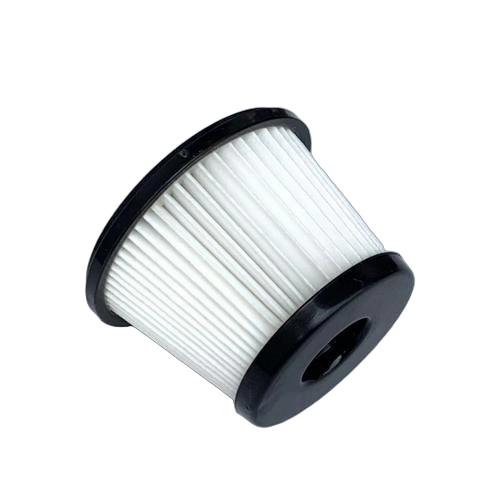
This conical HEPA filter element from Jyntrel is designed for handheld vacuums, robot vacuums, mattress cleaners, wet-dry vacs, and car mini vacuums. It captures fine dust, PM2.5, dust mites, pollen, and hair from the airstream before it leaves the dust cup. It suits appliance brands and OEM teams who need a drop-in or custom-shaped filter that keeps airflow high and protects the motor. Jyntrel manufactures it in Zhongshan, Guangdong, with PTFE membrane, composite PP, or antibacterial filter media.
In a handheld vacuum, the filter sits downstream of the dust cup and upstream of the motor. Air leaves the cup carrying fine particles, passes through the conical pleats, and exits to the motor and exhaust. The filter therefore has to hold dust without adding much resistance. High-porosity media and a conical fold pattern give a large effective area in a small housing, keeping pressure drop low as the filter loads. That helps maintain suction and battery run time while preventing motor overheating.
The operating environment matters. In a home, the filter sees dust, hair, and lint at room temperature. In a mattress cleaner, fine skin flakes and mite debris load the media quickly. In a car vacuum, temperature swings and vibration are common. Jyntrel selects media and pleat geometry for the target device and use pattern. Sealing is handled by an injection-moulded frame or a rubber gasket edge, so the filter fits the housing and limits dust bypass. The conical shape fits the tapered filter chamber used in many cordless stick vacuums.
The filter is built around three functions. First, fine-particle capture: the PTFE membrane and composite PP layers block PM2.5, dust mites, pollen, and hair, reducing secondary pollution from the exhaust. Second, low airflow resistance: the pleated cone geometry and high-porosity media keep resistance low, which supports stable suction and reduces motor load. Third, washability options: PTFE membrane versions can be washed and reused, while disposable HEPA versions prioritise filtration efficiency.
Jyntrel offers efficiency grades from H11 to H13. H13 media captures ≥99.95% of 0.3 μm particles. The conical pleat design increases surface area, so the filter holds more dust before resistance rises. For appliance makers, this balance between efficiency and pressure drop is the key selection point. The filter is not a standalone air purifier; it is a component tuned to the vacuum's airflow path and motor characteristics.
Because filter performance depends on the device, Jyntrel quotes from device data rather than from a catalogue number alone. To recommend the right media, pleat count, and frame, we ask for:
With these inputs, Jyntrel can match the conical dimensions, pleat count, end-cap material, and seal type. We support OEM/ODM customisation of size, structure, media grade, frame material, logo, and packaging. Over 1,000 filter solutions have been developed, and our team can work from a drawing, a sample, or a device model to build a 1:1 fit.
| Item | Detail |
|---|---|
| Product name | Vacuum cleaner filter element / robot vacuum filter |
| Core filter media | High-precision PTFE (microporous membrane) / composite PP (polypropylene meltblown) / antibacterial treated filter paper |
| Core purification function | Captures fine particles (PM2.5), dust mites, pollen, and hair from the dust cup; reduces secondary pollution from exhaust air |
| Physical fluid characteristics | High-porosity breathable design, very low operating airflow resistance, high dust-holding capacity, helps prevent motor overheating and supports battery run time |
| Main end applications | Handheld cordless vacuums, smart robot vacuums, mattress mite removers, wet-dry vacuums, car mini vacuums |
| Frame and size customisation | 100% custom manufacturing to device airflow path and dust cup dimensions; eco-friendly injection-moulded frame and rubber gasket edge options for airtight sealing |
| Company certification system | 50,000 m² modern production base and CNAS-recognised testing centre; ISO 9001, ISO 14001, and IATF 16949 quality management systems |
This conical filter element is used in handheld cordless vacuums, where space is tight and airflow must stay high. In robot vacuums, the conical shape fits compact filter bays and helps maintain suction as the bin fills. Mattress mite removers use the filter to trap fine dust and allergens close to the fabric surface. Wet-dry vacuums and car mini vacuums benefit from the low-resistance media when the motor runs at high speed. In each case, the filter is matched to the device's airflow path, dust load, and cleaning cycle.
Jyntrel operates multiple automated production lines with monthly capacity in the millions of pieces, which supports stable supply for appliance programmes. The 50,000 m² plant in Zhongshan, Guangdong, includes six clean workshops totalling 20,000 m². Filter media and finished elements are handled in controlled environments to limit contamination before packing.
The on-site laboratory is CNAS-recognised and can issue test reports for filtration efficiency, dust-holding capacity, and airflow resistance. Jyntrel holds ISO 9001, ISO 14001, and ISO 45001 system certifications, and has been IATF 16949 certified since 2024. Products meet REACH and RoHS requirements, and compliance documents can be provided. Quality control runs through IQC, IPQC, and OQC, so incoming media, in-process pleating and sealing, and finished filters are checked in sequence. With more than 20 years of export experience to Europe, the United States, Japan, and Korea, Jyntrel understands the documentation and consistency that appliance brands require.
To get a useful quote, send us your device or vehicle model, the filter size or a drawing, the target airflow or water flow (if applicable), the operating conditions (dust load, temperature, washable or disposable), and the quantity you expect. Our engineers will respond with a recommended media grade, pleat geometry, and sealing option. Contact Jyntrel to start the specification.
Yes. The conical pleat design and high-porosity media keep airflow resistance low, so the filter can operate at the higher velocities used in handheld vacuums. Jyntrel selects the pleat count and media grade for your device's airflow path, which helps maintain suction and limits motor load. Share your target airflow and we can recommend a configuration.
We need the target airflow or air velocity at the filter, the dust cup volume, and the device model or a drawing of the filter chamber. If you do not have measured data, a physical sample or 3D model is enough for our engineers to start. We also ask about the operating environment and whether the filter should be washable.
Jyntrel offers H11 to H13 grades. H13 media captures ≥99.95% of 0.3 μm particles, which covers PM2.5, pollen, dust mites, and fine dust. The actual efficiency in your device also depends on sealing and fit, so we match the frame and gasket to the housing.
Yes. We support full OEM/ODM customisation of conical dimensions, pleat count, media grade, end-cap material, gasket type, logo, and packaging. Provide a drawing, sample, or device model and we can develop a 1:1 fit. With over 1,000 filter solutions developed, our team is used to matching different filter chambers.
Standard samples can be provided free of charge, with the customer covering freight. Custom samples may carry a tooling or development fee, which can be credited against a mass-production order. To quote, send your device model, size or drawing, airflow target, operating conditions, and estimated quantity.
For standard specifications, the MOQ is typically 3,000 pieces. Custom moulded versions usually start at 5,000 pieces, depending on the specification. Standard lead time is 25–35 days after order confirmation, and we recommend confirming schedules early for peak-season or large-volume orders.
In normal household use, we suggest a replacement interval of 3–6 months, depending on usage frequency and dust load. Washable PTFE versions can be cleaned and reused 10–30 times, while disposable HEPA versions prioritise efficiency. Jyntrel can provide life-test data from our CNAS-recognised lab to support your recommended interval.
Yes, PTFE membrane versions are washable and can be cleaned and reused. Disposable HEPA versions are not intended for washing and are chosen when maximum efficiency is the priority. Let us know which approach fits your product positioning, and we will select the media accordingly.