
Uzyskaj rozwiązanie
PL-PL▼
Ten produkt jest kompatybilny z urządzeniami i zastosowaniami następujących marek lub do nich odpowiedni, wyłącznie jako pomoc przy wyborze. Znaki towarowe należą do ich odpowiednich właścicieli; nie oznaczają partnerstwa ani aprobaty.
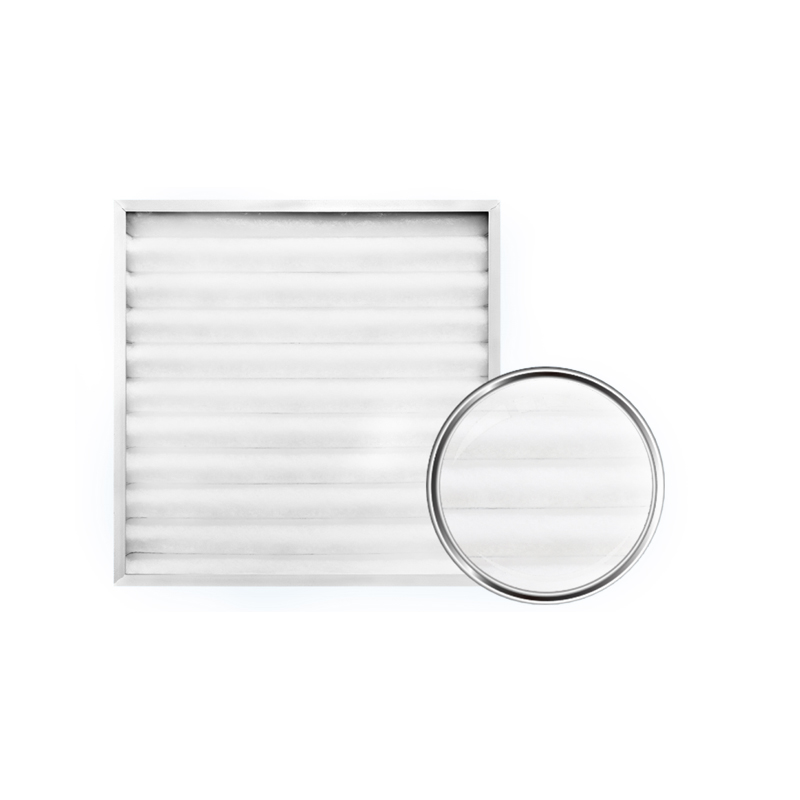
The Jyntrel metal frame non-woven fabric pre-filter is a coarse-grade (G3/G4) primary filter built around a polyester fibre media in a separable double-frame design, made for HVAC and ventilation systems that see high humidity and sustained airflow. It captures coarse dust, hair and fibres ahead of secondary or final filters, protecting AHU coils and downstream filter banks in commercial, pharmaceutical, food, automotive, energy, data-centre and microelectronics facilities. It is aimed at facility engineers, HVAC contractors and OEM equipment builders who specify by operating conditions rather than by catalogue size alone.
Place the filter where the air first enters the system: the fresh-air intake of an air handling unit, the pre-filter stage of a ducted ventilation run, or the intake of a compressor. At this point the air is fastest and dirtiest, and the filter's job is to take the coarse load before it reaches anything more expensive. The polyester fibre media is selected for toughness under that load and for resistance to moisture, so it holds its shape when the air stream carries humidity rather than shedding fibres into the duct.
The stated limits are a maximum operating temperature of 50 °C and a maximum relative humidity of 100%. Those two numbers define where this filter belongs: unconditioned plant rooms, humid exhaust paths, coastal fresh-air intakes and wash-down-adjacent ventilation, not hot process exhaust. Because the media tolerates saturated air, the filter can sit on the intake side of a system where condensation is routine.
Air velocity matters as much as cleanliness. A pre-filter sized too small will run at high face velocity, and the pressure drop climbs quickly as dust loads the media. The double-frame construction is the response to that: the media-carrying element is held in a rigid metal outer frame, and the two parts separate. When the media is spent, the load is released and the structural frame stays in service. In a system with several filter stages and frequent change-outs, that keeps the consumable cost tied to the media rather than to the whole assembly.
Filtration class is G3/G4 to EN 779, corresponding to the Coarse group under ISO 16890, with effective interception of particles of 5 µm and larger. In practice this is the grade that removes the visible load — dust, lint, hair, fibrous debris — and keeps it off the coils and the finer filters behind it. The benefit is measured in the life of the downstream bank and in the cleaning interval of the heat exchanger.
The media is a high-toughness polyester fibre chosen for high-humidity service. It combines high dust-holding capacity with low initial resistance and low lint shedding, so the filter does not become a particle source of its own. The frame is available in aluminium profile, galvanised steel or plastic, which lets the specification match the plant environment: aluminium where weight and corrosion resistance matter, galvanised where cost and rigidity dominate, plastic where the frame must be non-metallic.
Three frame depths are offered — 46 mm, 69 mm and 96 mm, roughly 2, 3 and 4 inches — so the filter can be matched to the slot depth of the existing holder without adapters. Standard face sizes include 594 × 289 mm, 594 × 492 mm and 594 × 594 mm, each in all three depths.
Selection starts with the air path, not the part number. To propose a filter we need the device or system model, the available frame size or a drawing of the holder, the design airflow through the filter position, and the operating conditions — temperature, relative humidity, and whether the air carries oil mist, coarse fibrous debris or corrosive vapour. Quantity and the required filtration class complete the picture.
Jyntrel supports OEM and ODM work on this product. Non-standard dimensions and frame thicknesses are customised to order, and frame material, media grade, logo and packaging can be specified. The company has developed more than 1,000 filtration solutions across its product range, and the 50,000 m² plant with its automated lines is set up to take both standard and bespoke runs.
| Item | Detail |
|---|---|
| Product name | Metal double-frame primary filter (metal frame non-woven fabric pre-filter) |
| Filter media | High-toughness polyester fibre, resistant to high humidity |
| Frame material | Aluminium profile, galvanised steel or plastic (selectable) |
| Operating limits | Maximum operating temperature 50 °C; maximum relative humidity 100% |
| Available depths | 46 mm / 69 mm / 96 mm (approximately 2 in, 3 in, 4 in) |
| Standard sizes (W × H × D, mm) | 594 × 289 × 46 / 69 / 96; 594 × 492 × 46 / 69 / 96; 594 × 594 × 46 / 69 / 96 |
| Filtration class | G3/G4 to EN 779 (Coarse to ISO 16890) |
| Typical use | Central AC pre-filtration in workshops, high-humidity exhaust air, cleanroom fresh-air intakes, air handling units (AHU) |
| Customisation | OEM/ODM: non-standard sizes and frame thicknesses; 50,000 m² plant and CNAS-accredited laboratory; ISO and IATF 16949 certified |
The filter is used as the first stage in commercial air conditioning and ventilation systems, where it protects cooling coils and downstream filters. In pharmaceutical and food processing plants it serves as the primary stage ahead of higher-grade filtration, and its tolerance of 100% relative humidity suits wash-down and humid process areas. Automotive and machinery plants use it on workshop AHU intakes where the air carries metal dust and lint; energy and metal smelting sites use it in high-humidity exhaust paths; and battery energy storage, data-centre and semiconductor facilities use it as intake protection for precision cooling equipment.
Production runs on multiple automated lines with a monthly capacity of millions of pieces, which supports repeat orders and scheduled change-out programmes rather than one-off batches. The 50,000 m² plant in Zhongshan, Guangdong includes six cleanrooms totalling 20,000 m². Jyntrel's own laboratory holds CNAS accreditation and can issue test reports on filtration efficiency, dust-holding capacity and resistance. The company has been certified to IATF 16949 since 2024 and also holds ISO 9001, ISO 14001 and ISO 45001 certification. Products comply with REACH and RoHS, and compliance documents are available. Quality control runs through IQC, IPQC and OQC at every stage, and more than 20 years of continuous export to Europe, the US, Japan and Korea underpins supply stability.
Send us the device or vehicle model, the frame size or a drawing of the holder, the design airflow, the operating temperature and humidity, and the quantity you expect. Our engineers will match the class, depth and frame material to the air path and come back with a quotation.
The filter is built for pre-filter positions where face velocity is highest. The rigid metal frame holds the media in place under sustained airflow, and the separable double-frame design keeps the structure in service when the media is changed. For correct sizing, send us the design airflow so the filter area can be matched to it.
We need the design airflow through the filter position, the available frame size or a drawing of the holder, the operating temperature and relative humidity, and the quantity. With those we can recommend class, depth and frame material. Contact us through the inquiry form and our engineers will respond.
It is rated G3/G4 to EN 779, corresponding to the Coarse group under ISO 16890, with effective interception of particles of 5 µm and larger. That makes it a first-stage filter ahead of finer grades, protecting coils and downstream filter banks. Efficiency is confirmed by test reports from our CNAS-accredited laboratory.
Yes. Non-standard sizes and frame thicknesses are customised to order, and frame material can be specified in aluminium, galvanised steel or plastic. Logo and packaging can also be customised under OEM/ODM. Send the drawing or sample details and we will confirm feasibility.
Standard-size samples can be provided for evaluation; please contact us with the size and quantity you need. Custom samples are quoted according to development complexity. Test reports on efficiency, dust-holding capacity and resistance can accompany the sample.
Standard sizes start at 500 pieces; custom specifications generally start at 1,000 pieces, with the exact figure confirmed per project. Standard orders typically ship in 15–25 days and custom orders in 25–35 days. Ask us to confirm against your schedule.
Under normal conditions the service life is about 2–3 months, depending on the cleanliness of the incoming air, the airflow and running hours. The separable double-frame design means only the media is replaced while the frame stays in service, which lowers consumable cost.
Yes. The polyester fibre media is selected for high-humidity service, and the filter is rated for up to 100% relative humidity at a maximum operating temperature of 50 °C. Tell us the actual conditions so the frame material can be matched to the environment.