
Uzyskaj rozwiązanie
PL-PL▼
Ten produkt jest kompatybilny z urządzeniami i zastosowaniami następujących marek lub do nich odpowiedni, wyłącznie jako pomoc przy wyborze. Znaki towarowe należą do ich odpowiednich właścicieli; nie oznaczają partnerstwa ani aprobaty.
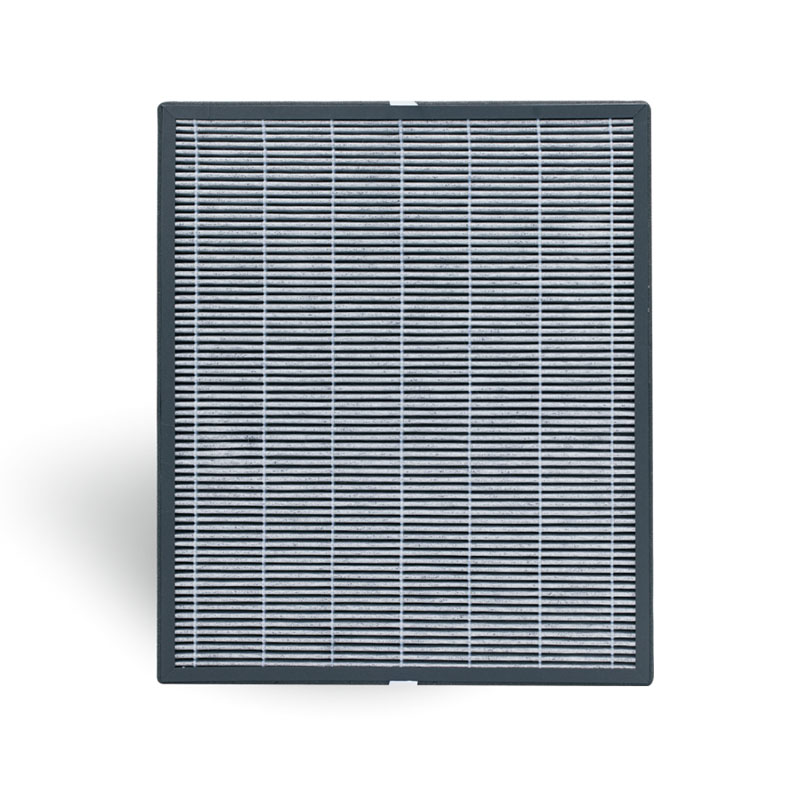
This plate-type activated carbon cloth filter is a flat, panel-format gas-phase filter that combines high-iodine honeycomb activated carbon with a formaldehyde-removal catalyst composite to adsorb and break down formaldehyde, benzene-series compounds and TVOCs. It is designed for air purifiers, fresh-air systems, vehicle HVAC and light commercial odour-control units where a thin, low-resistance carbon stage is needed. Jyntrel manufactures it in flat composite, honeycomb-filled and sintered carbon-block formats, including custom shapes, with performance verified in a CNAS-accredited laboratory.
Place the filter as the gas-phase stage after particulate removal, so the carbon cloth sees air with dust already stripped out. In a typical air purifier or fresh-air unit the panel sits in a framed slot, and airflow passes uniformly across its face; face velocity and the resulting residence time determine how much formaldehyde, benzene and TVOC the carbon can take up per pass. Lower face velocity gives longer contact and higher single-pass removal, while higher velocity reduces pressure drop but lowers efficiency per pass.
Relative humidity and temperature also matter. Condensing conditions or sustained high humidity can block carbon pores, so the filter is best used in the normal indoor range of air-handling equipment. For vehicle cabin filters and compact purifiers, the thin composite construction keeps the panel light and easy to seal at the frame edge, so air does not bypass the media. In fresh-air systems the same panel can be used as a polishing stage behind a primary particulate filter, protecting the carbon from coarse dust and extending service life.
The core of the product is high-iodine honeycomb activated carbon plus a composite catalyst for formaldehyde removal. The carbon adsorbs formaldehyde (HCHO), benzene-series compounds and TVOCs; the catalyst component is intended to promote decomposition of captured formaldehyde rather than storage alone. This makes the filter suitable where odour and VOC control are the main duty, not just particulate capture.
Performance depends on gas type, concentration, face velocity and contact time. In the supplied FAQ data, typical removal efficiency for VOC, odour, formaldehyde and benzene-series gases is stated as above 85%, with the exact figure depending on the gas and air velocity. Under normal operating conditions the service life is 6–12 months, adjusted for pollutant concentration and daily running hours. The filter is available in flat composite, honeycomb-filled and sintered carbon-block constructions, and custom shapes are supported for equipment with non-rectangular slots.
To select the right variant and quote accurately, we need the device or vehicle model, the available slot size or a drawing, the airflow or water flow (for air, m³/h at the operating point), and the operating conditions: temperature, relative humidity, target pollutants and their approximate concentrations. Quantity per order and per release also affect the production route and price.
Customisation covers frame material (paper, aluminium, plastic), dimensions, carbon weight, carbon type (coconut shell, coal-based, modified), laminate structure and packaging. Jyntrel has developed more than 1000 filter solutions and supports OEM/ODM work; our team can propose a carbon grade and panel build once the pollutant list and airflow data are clear. Send these details through the contact page to start the review.
| Item | Detail |
|---|---|
| Core construction materials | High-iodine honeycomb activated carbon; proprietary formaldehyde-removal catalyst composite |
| Main performance | High-efficiency adsorption and catalytic decomposition of formaldehyde (HCHO), benzene-series compounds and TVOCs |
| Structural options | Flat composite type, honeycomb-filled type, sintered carbon block (custom shapes supported) |
| Core applications | Home: air purifiers, fresh-air system pre/fine filtration, vehicle air-conditioning filter elements. Commercial/industrial: hospital cleanrooms, industrial exhaust treatment, odour-removal equipment |
| Quality and certification standards | Tested in a CNAS laboratory; RoHS compliant; factory IATF 16949 certified |
In home air purifiers and fresh-air systems, the panel is used as the gas-phase stage to reduce formaldehyde and odour from building materials and furnishings. In vehicle air-conditioning, the thin carbon cloth format fits compact filter slots and addresses cabin odours and VOC ingress. In commercial and industrial settings, it is used in hospital cleanrooms as a polishing stage, in industrial exhaust treatment for odour control, and in odour-removal equipment for workshops, painting booths and laboratories.
Because the construction can be flat composite, honeycomb-filled or sintered carbon block, the same product family covers low-profile slots in appliances and deeper housings in ducted equipment. For painting and coating operations, the carbon stage is usually placed after a particulate pre-filter to keep overspray off the carbon surface.
Jyntrel operates a 50,000 m² plant in Zhongshan, Guangdong, China, including six cleanrooms totalling 20,000 m². Multiple automated production lines support monthly output in the millions of pieces, which gives supply stability for programme volumes. The company has more than 20 years of filter development and manufacturing experience and has exported to Europe, the United States, Japan and South Korea for over 20 years.
Quality control runs through IQC, IPQC and OQC, and the in-house laboratory is CNAS-accredited, issuing reports on filtration efficiency, dust holding capacity and resistance. The factory holds IATF 16949 (obtained in 2024) and ISO 9001, ISO 14001 and ISO 45001 system certifications. Products meet REACH and RoHS requirements, and compliance documents can be supplied. These capabilities support stable batch performance for OEM/ODM programmes that specify carbon grade, panel size and packaging.
To move from specification to a quotation, tell us the device or vehicle model, the slot size or a drawing, the airflow or water flow, the operating temperature and humidity, the target pollutants, and the quantity you plan to order. With those inputs we can recommend a construction, carbon type and frame option, and confirm sample and production timing. Contact our team to start the selection review.
The panel can be used at elevated face velocity, but removal efficiency falls as velocity rises because contact time shortens. The stated typical removal of over 85% for VOC, odour, formaldehyde and benzene-series gases depends on gas type and air velocity. For high-velocity ducts, we recommend a larger face area or a deeper carbon stage to keep residence time in range.
We need the airflow at the operating point in m³/h, the slot dimensions or a drawing, and the expected pollutant concentrations. Temperature and relative humidity also help us select the carbon grade and panel thickness. With those inputs we can propose a construction and confirm pricing and samples.
Typical removal efficiency for VOC, odour, formaldehyde and benzene-series gases is above 85%, depending on gas type and air velocity. The carbon adsorbs these gases, and the catalyst composite is intended to decompose captured formaldehyde. For a specific target gas, share the concentration and airflow so we can confirm the expected performance.
Yes. The filter is available in flat composite, honeycomb-filled and sintered carbon-block formats, and custom shapes are supported. We can also adjust frame material, carbon weight, carbon type and packaging under OEM/ODM. Send a drawing or sample and our team will review feasibility and tooling needs.
Standard specifications typically start at 500–1,000 pieces per order, while customised products are quoted case by case based on tooling and material. Free samples are available for formal customers with freight paid by the customer; standard samples usually ship within 3 working days and custom samples take 7–15 days. Regular orders run 15–25 days, and large-volume orders generally take 30–45 days.
Under normal operating conditions the service life is 6–12 months, adjusted for pollutant concentration and daily running hours. High formaldehyde or VOC loading, or continuous operation, will shorten that interval. We recommend monitoring odour breakthrough or pressure drop and setting a replacement schedule from field data.
The 50,000 m² plant includes six cleanrooms totalling 20,000 m², and quality control covers IQC, IPQC and OQC. The CNAS-accredited laboratory tests filtration efficiency, dust holding capacity and resistance, and the factory holds IATF 16949 and ISO 9001, ISO 14001 and ISO 45001 certifications. These controls support stable performance across production lots.