
Obter solução
PT-BR▼
Este produto é compatível ou adequado para equipamentos e aplicações das seguintes marcas, apenas como referência para seleção. As marcas registradas pertencem aos seus respectivos proprietários; não implicam parceria ou endosso.
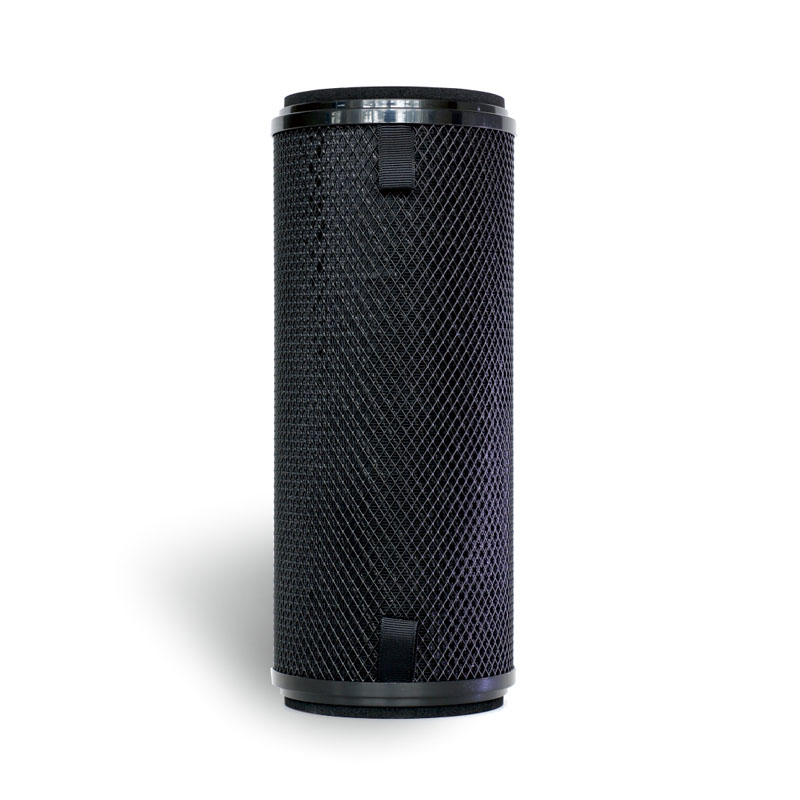
The Jyntrel cylindrical activated carbon filter is a round, high-iodine-value carbon filter designed to adsorb formaldehyde, benzene, ammonia, TVOC and odour compounds from the air stream. It is built for air purifiers, fresh-air ventilation pre-filtration, vehicle cabin air systems, central air-conditioning and industrial odour control. Jyntrel manufactures it in Zhongshan, Guangdong, China, and matches each cylinder to the customer's drawing or operating requirement. The sections below set out how the filter behaves in a duct or appliance air path, what data we need to size it, and how it is made and tested.
A cylindrical carbon filter sits directly in the air path, so its behaviour is governed by the air passing through it rather than by the carbon alone. Air enters through the outer circumference, passes radially through the carbon bed and exits through the open core or the end face, depending on the housing design agreed with the customer. The carbon bed therefore sees the full face velocity of the system, and the balance between cylinder diameter, bed depth and open area decides whether the filter adds meaningful resistance or very little.
Low resistance is a design objective of this product, because in an air purifier or fresh-air unit the carbon stage shares the fan's static pressure budget with the particle filter. A cylinder with a generous outer surface and a correctly proportioned bed lets the unit hold its rated airflow without the fan being pushed up its curve. In systems where airflow is fixed by the appliance, the same property keeps the motor load and the noise signature close to the design point.
Environment matters as much as airflow. In residential and office use the carbon sees low and moderate pollutant concentrations with continuous or intermittent operation. In commercial kitchen exhaust, laboratory ventilation and industrial odour pretreatment the inlet load is higher and more variable, and the carbon mass and contact time need to be set accordingly. Temperature, relative humidity and the presence of dust or grease all influence service life, which is why we ask for operating conditions before proposing a carbon grade and fill weight.
The adsorption medium is a high-iodine-value activated carbon selected for gas-phase work. It is intended to capture and hold formaldehyde, benzene, ammonia, TVOC and a broad range of odour compounds, which are the target substances named for this product. Because the carbon is the functional layer, performance is expressed through the carbon grade and fill weight rather than through a single headline number.
Under normal operating conditions the filter's service life is typically 6 to 12 months, depending on pollutant concentration in the inlet air and on the airflow passing through the cylinder. Higher concentrations and higher continuous airflow consume capacity sooner; cleaner inlet air and intermittent operation extend it. We recommend that replacement be triggered by the appliance's own indicator, by odour breakthrough, or by a scheduled interval derived from the measured inlet load.
Because the filter is a gas-phase stage, it is normally paired with a particle filter upstream. Dust loading on the carbon surface reduces the accessible adsorption area, so keeping coarse dust out of the cylinder protects the capacity the carbon was selected to deliver.
Every cylinder is made to the customer's drawing or requirement. Sizes, carbon type and fill weight, end-cap arrangement and packaging are all defined during selection, and we can develop against a drawing or a physical sample. To propose the right configuration, we ask for the following:
With these inputs we can compare carbon grades and fill weights, check that the proposed cylinder fits the pressure budget of the fan, and confirm a sample route before tooling or volume production.
| Item | Detail |
|---|---|
| Core filtration material | High-iodine-value activated carbon |
| Product form and size | Cylindrical; fully customised to customer drawings or requirements |
| Main purification performance | High-efficiency adsorption and removal of formaldehyde, benzene, ammonia, TVOC and various odours |
| Core application scenarios | Air purifiers, fresh-air system pre-filtration, vehicle air-conditioning filters, central air-conditioning systems, industrial exhaust odour removal |
| Manufacturer brand | Zhongshan company products Co., Ltd. (the company) |
In air purifiers the cylinder is usually the gas-phase stage behind a particle filter, sized to the appliance's rated airflow and to the replacement interval the brand promises. In fresh-air ventilation systems it serves as pre-filtration, taking odours and gaseous pollutants out of incoming outdoor air before the main filtration stage. Vehicle air-conditioning filters use the same cylindrical form where the housing allows a round element, targeting cabin odours and traffic-related gases.
Central air-conditioning systems use cylindrical carbon filters where return-air odours or outdoor pollutants need control at the zone level. In industrial exhaust odour removal the filter works as a pretreatment or polishing stage ahead of, or alongside, other gas treatment, and the carbon grade is chosen for the specific compound family present. Across these applications the selection logic is the same: match bed depth and carbon mass to airflow, inlet load and the service interval the system can accept.
Jyntrel has more than 20 years of experience in filtration research and manufacturing and has exported to Europe, the United States, Japan and South Korea for over 20 years, which gives customers a stable supply base for repeat programmes. Multiple automated production lines support a monthly capacity of several million pieces, so volume orders and seasonal peaks can be scheduled with confidence.
The production base covers 50,000 m², including six clean workshops totalling 20,000 m². Our in-house laboratory is CNAS-accredited and can issue test reports on filtration efficiency, dust holding capacity and resistance, so the gas-phase and airflow behaviour of a proposed cylinder can be checked before volume release. Quality control runs through IQC, IPQC and OQC at each stage.
The company holds ISO 9001, ISO 14001 and ISO 45001 certification, and achieved IATF 16949 automotive quality management certification in 2024. Products meet the REACH and RoHS environmental requirements, and compliance documentation can be supplied. OEM and ODM work is standard practice: size and structure, filter material grade, frame material, logo and packaging can all be customised, and more than 1,000 filtration solutions have been developed to date. Manufacturing is located in Zhongshan, Guangdong, China.
Send us your device or system model, the required size or a drawing, the airflow through the filter stage, the operating conditions (pollutant load, temperature, humidity) and your quantity. Our engineering team will respond with a carbon grade and cylinder configuration suited to your air path, along with sample and volume production options. Start the conversation through our contact page.
The cylinder is designed for low resistance in the air path, and the carbon bed is sized so the filter stage stays within the fan's pressure budget. At high face velocity, contact time per pass shortens, so we adjust bed depth and carbon mass to the airflow you specify. Share your rated airflow and we will confirm a suitable configuration.
We need the rated airflow through the filter stage and the static pressure the fan or system can spare for it. The available space, or the inner diameter, outer diameter and height, is equally important. Inlet pollutant profile, temperature and humidity help us choose the carbon grade.
Each cylinder is made to your drawing, sample or stated requirement, covering diameter, height, carbon type and fill weight. We compare the proposed element against your airflow and pressure budget before sampling. OEM and ODM customisation is standard for this product.
Yes. We support sample evaluation before volume commitment, and the sample is built to the drawing or requirement agreed with your team. Send the size, airflow and operating conditions so the sample reflects your real air path. Sample terms and pricing are confirmed with the quotation.
MOQ and lead time depend on the cylinder size, carbon grade and customisation level, and are confirmed in the quotation for your configuration. Capacity of several million pieces per month across automated lines supports both trial and volume orders. Your required delivery date is scheduled when the order is placed.
Under normal operating conditions service life is typically 6 to 12 months, depending on pollutant concentration and airflow through the cylinder. Higher inlet loads shorten it, and cleaner air extends it. Replacement can follow the appliance indicator, odour breakthrough, or a scheduled interval based on measured inlet load.
The high-iodine-value activated carbon targets formaldehyde, benzene, ammonia, TVOC and a broad range of odour compounds. It is a gas-phase stage and is normally paired with a particle filter upstream to keep dust off the carbon. For specific compound families in industrial exhaust, we select the carbon grade accordingly.
Products meet the REACH and RoHS environmental requirements, and compliance documentation can be provided. The company holds ISO 9001, ISO 14001 and ISO 45001 certification and achieved IATF 16949 certification in 2024. Tell us the destination market and we will confirm the documents needed. Contact us to start your inquiry.