
Obter solução
PT-BR▼
Este produto é compatível ou adequado para equipamentos e aplicações das seguintes marcas, apenas como referência para seleção. As marcas registradas pertencem aos seus respectivos proprietários; não implicam parceria ou endosso.
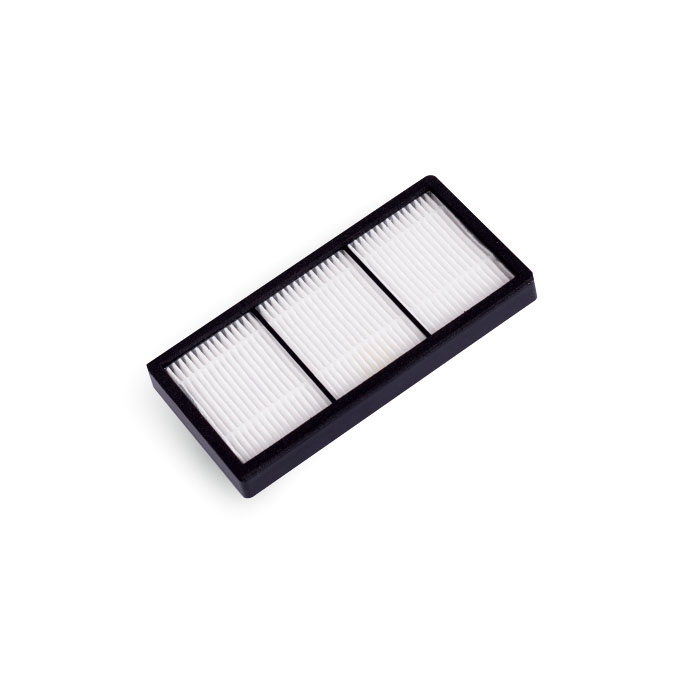
This is a dust box HEPA filter for robot vacuums and handheld vacuums, built to capture PM2.5, fine dust, dust mites, pollen and pet dander before air leaves the machine and re-enters the room. It is made with high-precision PTFE microporous membrane or composite PP meltblown media, and is supplied by Jyntrel as a washable filter in custom sizes. It suits vacuum OEMs, appliance brands and aftermarket programmes that need a low-resistance filter matched to a specific dust box.
In a robot vacuum or handheld unit, the filter sits at the end of a short, fast air path. The motor pulls air through the dust box, and the filter is the final barrier before exhaust. That position defines the requirements: the media must hold fine particles while adding as little resistance as possible, because every extra pascal of pressure drop is taken directly from suction at the floor nozzle and from battery runtime.
Jyntrel approaches this as a system question rather than a material question. We look at the airflow the motor delivers, the face velocity across the filter, the dust load the bin is expected to hold, and whether the filter will be washed. A high-porosity breathing design keeps restriction low during normal operation, while the PTFE membrane layer provides the fine-particle barrier. The same logic applies to handheld vacuums, bed mite removers, car mini vacuums and wet-dry floor cleaners, where dust box geometry and airflow differ from model to model.
Because dust boxes are compact, filter area is limited. The design therefore balances media grade, pleat or frame geometry and sealing at the edge so that air passes through the media rather than around it. Edge sealing is handled with an overmoulded rubber edge where the housing requires it.
The filter is specified for strong interception of PM2.5, fine dust, dust mites, pollen and pet dander, which prevents the secondary pollution that occurs when exhaust air carries fine particles back into the room. The microporous structure is the main capture layer; the composite PP meltblown grades provide graded filtration at lower cost, while PTFE membrane versions add a moisture-resistant, washable surface.
Low airflow resistance is the second design target. A high-porosity, breathable construction keeps pressure drop low so the motor does not lose suction and battery runtime is not shortened unnecessarily. High strength and dirt tolerance matter in this duty: dust boxes are emptied and refilled repeatedly, and washable filters are rinsed between cycles, so the media and frame must hold their shape through that handling.
Filter class is selected with the customer. H11, H12 and H13 grades are available across the range, and the final grade is fixed against the airflow data and the target market requirements for each model.
Every dust box is different, so this filter is made to the device rather than to a catalogue size. Jyntrel offers 100% customisation to the dust box dimensions, with eco-friendly injection-moulded frames and edge sealing, and supports scale production of washable PTFE-coated versions. We can also customise frame material, filter grade, colour, logo and packaging.
To quote accurately we need: the device or vehicle model, the dust box size or a drawing, the airflow the motor delivers, the operating conditions (dry dust only, or wet pickup nearby; expected wash frequency; ambient humidity), and the order quantity. With that data we can propose a media grade and frame geometry, then confirm with a sample. Where no drawing exists, a physical sample can be measured and used to build the tooling.
| Item | Detail |
|---|---|
| Product name | Robot vacuum filter / handheld vacuum filter element |
| Core filtration material | High-precision PTFE (microporous polytetrafluoroethylene) membrane / composite PP (polypropylene meltblown) and other moisture-resistant, antibacterial media |
| Core purification function | Strong interception of PM2.5, fine dust, dust mites, pollen and pet dander inside the vacuum, preventing secondary pollution from exhaust air |
| Physical fluid characteristics | High-porosity breathable design with very low operating airflow resistance; does not waste motor suction and supports device battery runtime |
| Main end applications | Smart robot vacuums, handheld cordless vacuums, bed mite removers, car mini vacuums, wet-dry floor cleaners |
| Frame and size customisation | 100% customised to the device dust box size; eco-friendly injection-moulded frames, edge overmoulded sealing; scale OEM production of washable material (PTFE-coated versions) |
| Company certification system | 50,000 m² modern production base and a national CNAS testing centre; ISO 9001, ISO 14001 and IATF 16949 quality management systems |
Jyntrel runs multiple automated production lines capable of millions of pieces per month, which supports stable supply for appliance programmes and aftermarket ranges. The company has more than 20 years of filtration product development and manufacturing experience, and has exported to Europe, the United States, Japan and Korea for over 20 years. The production base covers 50,000 m², including six clean workshops totalling 20,000 m².
Testing is carried out in the company's own laboratory, which is CNAS-accredited and can issue reports on filtration efficiency, dust holding capacity and resistance. Quality control follows IQC incoming inspection, IPQC in-process inspection and OQC outgoing inspection. Jyntrel holds ISO 9001, ISO 14001 and ISO 45001 certification, and was certified to IATF 16949 in 2024. Products meet REACH and RoHS requirements and compliance documents can be provided. The company is located in Zhongshan, Guangdong, China.
Send us your device or vehicle model, dust box size or drawing, motor airflow, operating conditions and quantity, and our engineering team will propose a filter grade and frame design for your air path. Start here: contact Jyntrel.
The filter is available in H11, H12 and H13 grades across the range. The final grade is selected against your motor airflow, dust load and target market requirements, and efficiency is verified in Jyntrel's CNAS-accredited laboratory.
Yes. The high-porosity, breathable media is designed for the short, fast air path of robot and handheld vacuums, keeping operating resistance low so the motor does not lose suction. Share your motor airflow and we will match the media grade to it.
Yes. Jyntrel customises 100% to the dust box size, with injection-moulded frames and edge overmoulded sealing, plus custom filter grade, frame material, colour, logo and packaging. A drawing, sample or device model is enough to start.
Send the device or vehicle model, dust box size or drawing, the airflow the motor delivers, the operating conditions (dust type, wash frequency, humidity) and the quantity. With that we can propose a media grade and frame geometry and confirm with a sample.
MOQ and lead time are confirmed per specification once the size, grade and quantity are known, and customised items are quoted after the design is reviewed. Contact us with your requirements for a specific quote.
For washable PTFE-coated versions, rinse according to your device instructions; exact wash life and replacement interval are confirmed for the selected media grade. The filter should be replaced when suction drops or the media no longer cleans up.
Yes. Samples are arranged against the confirmed size, grade and quantity, and are produced after the design is agreed. Send your drawing or sample so we can prepare the sample to your dust box.
Lead time depends on whether the item uses existing tooling or needs new tooling, and on order quantity. Jyntrel's automated lines support millions of pieces per month, so send your quantity and schedule for a confirmed lead time.