
Obter solução
PT-BR▼
Este produto é compatível ou adequado para equipamentos e aplicações das seguintes marcas, apenas como referência para seleção. As marcas registradas pertencem aos seus respectivos proprietários; não implicam parceria ou endosso.
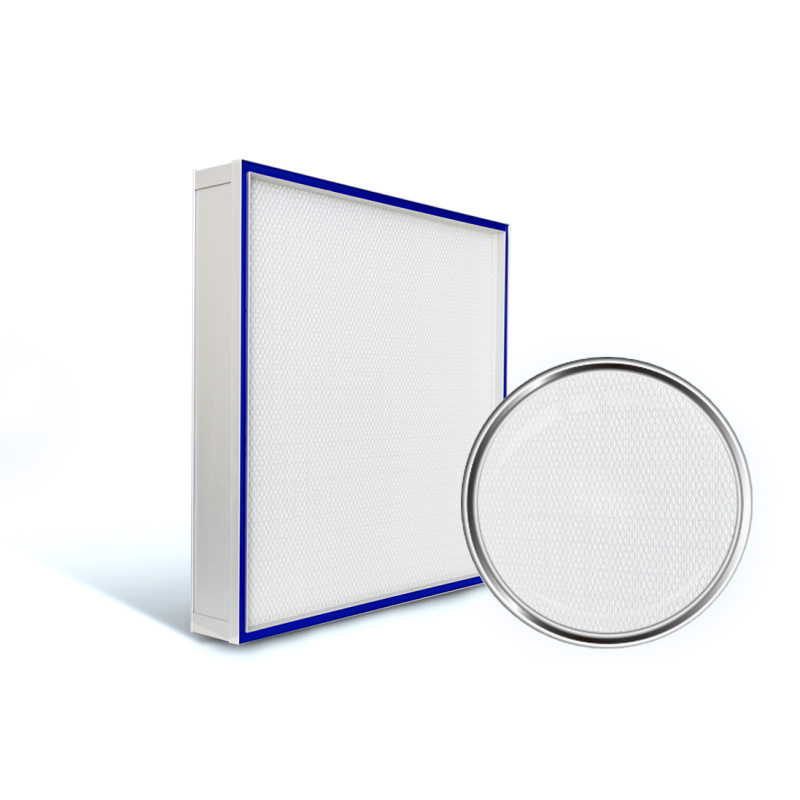
The Jyntrel gel seal HEPA & ULPA filter is a high-efficiency panel filter for cleanrooms and critical ventilation systems, sealed into its housing through a continuous gel trough rather than a compressed gasket. It removes particulate from the air at H12, H13, H14 and U15 grades, using ultra-fine glass fibre media in an anodised aluminium frame. It is specified for semiconductor and microelectronics cleanrooms, GMP pharmaceutical areas, hospital operating rooms, FFU units and high-specification coating lines — anywhere the air path must stay sealed at the filter-to-housing interface.
Gel seal filters are chosen because of how they behave inside the system, not only on a data sheet. Air enters the face of the panel, passes through the glass fibre medium, and leaves through the downstream face into the clean space. The frame sits in a knife-edge trough filled with polyurethane gel, so the seal is continuous around the whole perimeter. That matters in systems where the fan or FFU cycles on and off, where differential pressure pulses across the filter, or where the housing expands and contracts with temperature.
Velocity and face loading drive the pressure drop you will see in service. The standard sizes below give the relationship in practical terms: a 610×610×50 mm side-gel filter is rated at 1000 m³/h, the 1170×570×50 mm at 1800 m³/h; in the 70 mm top-gel format the same footprints are rated at 750 m³/h and 1300 m³/h. Larger specifications are supported up to 3600 m³/h. Because gel seal housings tolerate repeated filter changes without bolt torque settings, the air path stays predictable across change-out cycles.
The medium is high-flux, water-resistant ultra-fine glass fibre, selected so that the filter holds its efficiency in humid or condensation-prone air paths as well as in dry cleanroom recirculation. Efficiency grades run from H12 through H13, H14 and U15, in line with EN 1822 classification. The frame is anodised aluminium profile with polyurethane gel sealant, and both top-gel and side-gel configurations are available so the filter can match the housing already installed in your ceiling grid or FFU.
The gel trough is the defining feature. A gasket seal depends on mechanical compression, which can relax or be fitted unevenly; a gel seal fills the gap and re-seals around the knife edge each time a filter is seated. The result is a barrier against bypass leakage at the frame, which is where high-grade cleanrooms most often lose performance. The same construction suits ceilings where filters are changed from below and systems where the filter is loaded from the top.
Selection starts with the housing, not the filter. Tell us whether your ceiling grid or FFU takes a top-gel or side-gel filter and the frame depth, then give the face dimensions and the airflow per unit. From there we confirm the efficiency grade, the number of units, and the media area needed to keep velocity and pressure drop within your fan curve.
Non-standard sizes, gel trough widths and airflow requirements are supported under OEM/ODM. We can also discuss frame material and packaging or labelling requirements with your engineering team, and our engineers can work from your drawing. The more of the following you can share, the faster a quotation can be issued: device or housing model, nominal size or drawing, rated airflow, operating temperature and humidity, upstream pre-filtration, and quantity.
| Item | Detail |
|---|---|
| Product name | Gel Seal HEPA & ULPA Filter (high-efficiency panel type) |
| Filter class (EN 1822) | H12 / H13 / H14 (HEPA) / U15 (ULPA) |
| Filter medium | High-flux, water-resistant ultra-fine glass fibre |
| Frame and seal | Anodised aluminium profile with polyurethane gel sealant |
| Installation format | Top gel seal / side gel seal |
| Typical applications | Semiconductor wafer cleanrooms, biopharma GMP workshops, hospital Class 100 operating rooms, FFU equipment, high-standard coating lines |
| Standard sizes and rated airflow (W × H × D) | Side gel, 50 mm depth: 610×610×50 mm (1000 m³/h); 1170×570×50 mm (1800 m³/h). Top gel, 70 mm depth: 610×610×70 mm (750 m³/h); 1170×570×70 mm (1300 m³/h). Larger airflow specifications supported up to 3600 m³/h. |
| Customisation (OEM/ODM) | Non-standard sizes, gel trough widths and airflow requirements supported; production at the 50,000 m² plant with CNAS laboratory and ISO/IATF16949 systems |
These filters are used where the cleanroom class is tight and the cost of a leak is high. In semiconductor wafer fabrication and microelectronics cleanrooms they sit at the FFU and ceiling grid, protecting the process environment at ISO Class 1–5. In biopharmaceutical GMP workshops and hospital Class 100 operating rooms, the gel seal keeps the boundary between filtered and unfiltered air intact. They are also specified in high-standard paint and coating lines, and in cleanroom ventilation serving energy, metal and food processing operations where particulate control is part of the process.
Jyntrel manufactures in Zhongshan, Guangdong, China, on a 50,000 m² plant that includes six clean workshops totalling 20,000 m². Multiple automated production lines give a monthly capacity of millions of pieces, which is what keeps lead times stable for programmes running over several years. More than 20 years of export experience to Europe, the United States, Japan and Korea supports customers who need consistent supply and documentation across borders.
The in-house laboratory is CNAS-accredited and can issue test reports covering filtration efficiency, dust holding capacity and resistance. The company holds ISO 9001, ISO 14001 and ISO 45001 certification, and obtained IATF16949 automotive quality management certification in 2024. IQC, IPQC and OQC controls run through the whole process, and products meet REACH and RoHS requirements with compliance documents available on request. For buyers who need to qualify a supplier before a cleanroom project, these are the points to review first.
Send us the device or housing model, the size or a drawing, the airflow or water flow, the operating conditions and the quantity you expect to order. Our team will come back with a suitable efficiency grade, format and quotation. Contact Jyntrel to start the selection.
Rated airflow depends on size and format: a 610×610×50 mm side-gel unit is rated at 1000 m³/h and the 1170×570×50 mm at 1800 m³/h, with larger specifications up to 3600 m³/h. Share the airflow per filter and the housing dimensions and we will confirm the right size and expected pressure drop for your system.
We need the rated airflow per filter or per FFU, the face dimensions and frame depth, and whether the housing uses top-gel or side-gel sealing. The operating temperature, humidity, upstream pre-filtration and quantity also help us match the correct efficiency grade.
The range covers H12, H13, H14 and U15 under EN 1822, using ultra-fine glass fibre media. H13 and H14 suit most HEPA cleanroom ceilings and FFU systems, while U15 is specified where ULPA-level particulate control is required. The gel seal prevents bypass at the frame, which is where cleanroom performance is most often lost.
Yes. OEM/ODM customisation covers non-standard dimensions, gel trough widths, airflow requirements, frame options, labelling and packaging. Send a drawing or the housing model and our engineers will confirm feasibility and the quotation.
Samples can be arranged for evaluation before a full order, and the minimum order quantity is confirmed with the quotation based on size and specification. Share your required grade, size and airflow so we can propose the closest standard unit or a custom build.
Lead time depends on size, efficiency grade and order volume, and is confirmed when the order is placed. Our automated lines across the 50,000 m² plant support monthly output in the millions of pieces, which helps keep delivery stable for repeat and long-term programmes.
Replacement is normally judged by resistance: change the filter when it reaches the terminal pressure drop set for your system, or earlier if monitoring shows a decline in performance. Operating hours, upstream pre-filtration and cleanliness of the air path all affect service life, so we recommend agreeing a change-out threshold with your HVAC engineer.
Send the device or housing model, size or drawing, airflow, operating conditions and quantity through our contact page. We will respond with a recommended grade and format, plus a quotation. Visit <a href="/en/contact">our contact page</a> to begin.