
Получить решение
RU-RU▼
Данный продукт совместим с оборудованием и решениями следующих брендов или подходит для них; приведён только для справки при выборе. Товарные знаки принадлежат их соответствующим владельцам и не означают сотрудничество или одобрение.
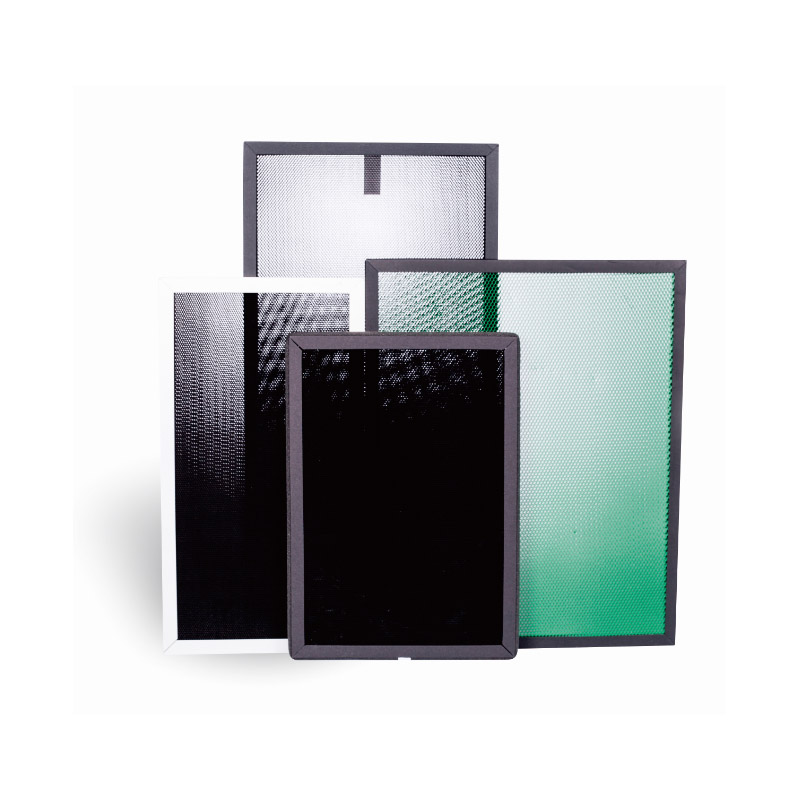
The Jyntrel ozone removal filter is an aluminum honeycomb catalytic filter that converts ozone into oxygen as air passes through it. It is designed for commercial HVAC systems, laser printers, copiers, ozone sterilizers, and medical equipment exhausts. It suits engineers and product teams who need to meet indoor ozone limits such as 0.16 mg/m³ (China) or UL867 (≤0.1 mg/m³). Jyntrel manufactures it in Zhongshan, Guangdong, China, using a patented catalyst and offers full size customisation.
Ozone removal depends on how the air moves through the filter. The honeycomb structure presents many parallel channels; as air passes, ozone molecules contact the catalyst coating on the aluminum substrate and are decomposed. The open frontal area keeps pressure drop low at typical HVAC face velocities, so the filter can be placed in the airstream without overloading the fan.
For selection, we consider the ozone concentration at the filter inlet (ppm or mg/m³), the face velocity (m/s), and the required outlet concentration. Temperature and humidity also affect performance and are part of the specification. The filter is intended for dry air streams; for high-humidity or high-temperature applications, please consult Jyntrel with details.
The filter is typically installed after the ozone source—for example, downstream of electrostatic precipitators in air purifiers or in the exhaust path of ozone sterilizers. The aluminum honeycomb can be cut to various thicknesses, and optional aluminum frames or sponge/EVA sealing edges help maintain a tight fit and prevent air bypass.
The core of the filter is a patented catalyst (Chinese invention patent ZL200710026260.6) coated onto an aluminum honeycomb carrier. This catalyst is designed to decompose ozone at room temperature without consumable chemicals. The honeycomb geometry provides a large contact area while keeping resistance to airflow low, which helps maintain energy efficiency in ventilation systems.
Jyntrel tests the filter to verify that treated air meets the Chinese national standard of less than 0.16 mg/m³ and the UL867 requirement of ≤0.1 mg/m³ for ozone emission from equipment. These tests are conducted in Jyntrel's CNAS-accredited laboratory. The filter does not release ozone or other by-products; the reaction converts ozone to oxygen.
Because performance depends on residence time, lower face velocities generally improve efficiency. We provide guidance on matching filter thickness and cell density to your airflow and target outlet concentration.
Jyntrel supplies the ozone removal filter in custom sizes to fit your equipment. To recommend the right configuration, we ask for the following information:
With these details, we can specify the honeycomb thickness, cell density, and catalyst loading. We also offer optional aluminum frames, sponge or EVA gaskets, and custom packaging. If you are unsure about any parameter, our engineers can work with your test data.
| Item | Detail |
|---|---|
| Product name | Ozone Removal Filter / ozone decomposition catalytic filter |
| Core structure and material | Aluminum honeycomb carrier with proprietary ozone removal catalyst coating |
| Patent | Chinese invention patent ZL200710026260.6 |
| Ozone treatment standard | Treated indoor ozone concentration below 0.16 mg/m³ (Chinese national standard); meets UL867 (≤0.1 mg/m³) testing requirements |
| Main application terminals | High-voltage electrostatic air purifiers, large laser printers, commercial copiers, ozone sterilizer exhaust treatment, medical device exhaust ports |
| Frame and size customisation | 100% customised to customer equipment dimensions; aluminum honeycomb cut to various thicknesses; optional aluminum alloy frame, sponge/EVA sealing edge strips for installation airtightness |
| Quality system certification | Manufactured in a 50,000 m² clean production facility with a national CNAS testing centre; company follows ISO 9001/14001 and IATF 16949 quality management systems |
The ozone removal filter is used wherever ozone is generated as a by-product or for sterilisation. Common applications include:
The filter can be combined with medium-efficiency pre-filters and HEPA filters in multi-stage systems. Its low profile and custom dimensions make it suitable for retrofits as well as new equipment designs.
Jyntrel has more than 20 years of experience in filter manufacturing and export. Our Zhongshan facility covers 50,000 m², including 20,000 m² of clean workshops across 6 rooms. Multiple automated production lines support a monthly capacity of millions of pieces, which helps maintain stable supply for OEM programmes. We have been exporting to Europe, the United States, Japan, and South Korea for over 20 years.
Quality management is built into every stage: incoming material inspection (IQC), in-process checks (IPQC), and outgoing inspection (OQC). Our CNAS-accredited laboratory can issue test reports for filtration efficiency, dust holding capacity, and pressure drop, giving customers documented performance data. We are certified to ISO 9001, ISO 14001, and IATF 16949 (2024), and our products comply with REACH and RoHS requirements.
For custom projects, we support OEM/ODM development of dimensions, structures, filter media grades, frame materials, logos, and packaging. Over 1,000 filter solutions have been developed to date.
To receive a tailored quotation for the Jyntrel ozone removal filter, please provide:
Send these details through our contact page. Our engineers will review your requirements and recommend a filter configuration. We can also supply samples for evaluation; please indicate your sample needs in your inquiry.
The aluminum honeycomb design maintains low pressure drop at typical HVAC face velocities, but ozone removal efficiency depends on residence time. Higher velocities reduce contact time, so for high-velocity systems we may recommend a thicker honeycomb or a larger filter face area. Please share your face velocity and target outlet concentration for a specific recommendation.
We need the airflow rate (m³/h or CFM) and the face velocity (m/s) at the filter location. Also provide the inlet ozone concentration and the required outlet concentration, as these determine the catalyst loading and filter thickness. A dimensional drawing or sketch of the installation space helps us propose a drop-in replacement.
Under standard test conditions (0.1 ppm ozone, 1.0 m/s face velocity), Jyntrel's ozone removal filter achieves over 95% ozone removal efficiency. Actual efficiency in your system depends on residence time, ozone concentration, temperature, and humidity. We can provide test data from our CNAS laboratory to support your validation.
Yes. Jyntrel offers 100% customisation of outer dimensions, honeycomb thickness, and frame options. We can cut the aluminum honeycomb to your specified size and add aluminum alloy frames or sponge/EVA sealing edges to ensure a tight fit. Please provide a drawing or sample for the most accurate match.
For custom ozone removal filters, the MOQ is typically 1,000 pieces, but this can vary with size and configuration. Sample development takes about 10–15 days, and bulk production lead time is usually 25–35 days after drawing approval. For standard sizes, please inquire for current stock and shorter lead times.
Replacement interval depends on operating conditions. In typical commercial HVAC applications, the filter lasts 12–18 months. In high-ozone or high-particulate environments, more frequent replacement may be needed. We recommend monitoring outlet ozone concentration or scheduling replacement based on pressure drop and visual inspection.
Yes, we welcome sample requests for performance evaluation. Standard-size samples are usually provided free of charge, with freight collected. Custom samples may incur a development fee, which can be credited against a bulk order. Please contact us with your specifications and testing requirements.
Yes. Our CNAS-accredited laboratory can issue test reports for ozone removal efficiency and pressure drop. These reports are based on our in-house testing and are available to support your compliance documentation. Please let us know your specific testing needs when you inquire.