
Teklif Alın
TR-TR▼
Bu ürün, aşağıdaki markaların ekipman ve uygulamalarıyla uyumludur veya bunlara uygundur; yalnızca seçim referansı içindir. Ticari markalar ilgili sahiplerine aittir; ortaklık veya onay anlamına gelmez.
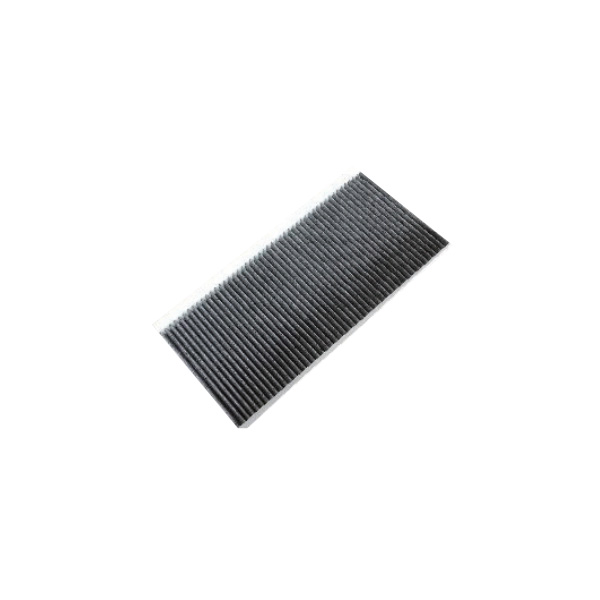
This is a two-stage cabin air filter for vehicle HVAC systems: a high-precision HEPA filter medium combined with high-iodine coconut-shell granular activated carbon. It captures PM2.5 particulate and dust while adsorbing ammonia, sulphides and traffic-related VOCs before they reach the cabin. It is built for passenger cars, coaches, heavy trucks and construction machinery, and is supplied by Jyntrel as an OEM/ODM part in any length, width, thickness and pleat count required by the original air duct.
In a cabin HVAC system the filter sits in the outside-air and recirculation path, downstream of the blower intake and upstream of the evaporator. Everything the blower moves passes through it, so its behaviour is set by the duty point of that system: face velocity across the media, the pressure drop it adds at each blower speed, and the contaminant load in the incoming air.
Two conditions govern performance. The first is airflow. A pleated medium presents a large effective area in a shallow frame; the pleat count and pleat depth determine how that area is distributed and therefore how the filter behaves as velocity rises. The second is environment. A vehicle operated in dense traffic draws a continuous stream of diesel and petrol exhaust; one operated on unpaved roads draws dust; a coastal or humid climate adds moisture cycling. The carbon stage is sized for the odor load, the particulate stage for the dust load.
The design intent is straightforward: keep restriction low enough that blower output and cabin comfort are not noticeably reduced, while holding enough media and carbon to remain effective across the service interval. Low airflow resistance and high dust holding capacity are the two fluid properties Jyntrel specifies for this product.
The particulate stage is a high-precision HEPA medium that blocks PM2.5 particles and dust. In testing, filtration efficiency for PM2.5 reaches 95% or above, and the same composite structure adsorbs cabin odors, formaldehyde, benzene-series compounds and other VOCs.
The odor stage uses high-iodine coconut-shell granular activated carbon, selected for its adsorption capacity against ammonia, sulphides and exhaust VOCs. Placing a carbon layer behind a fine particulate medium protects the carbon from coarse dust, which is what allows the odor function to last through the service interval rather than loading up in the first weeks.
The pleating process is engineered for low resistance. Air moves through the pleat channels with low friction loss, so the HVAC fan does not have to work harder to deliver the same airflow, and the media holds a high dust load before restriction climbs.
Because this is a duct-matched part, selection starts with the vehicle, not the catalogue. Jyntrel supports 100% OEM/ODM customisation across vehicle models, producing any length, width, thickness and pleat count to suit a specific original HVAC air path. More than 1,000 filtration solutions have been developed to date.
To quote accurately, send the device or vehicle model and year, the existing filter's dimensions or a drawing, the airflow or blower data for the system, the operating conditions (traffic density, dust, humidity, cabin volume), the quantity per order and per year, and any packaging or branding requirement. With those inputs the medium grade, carbon loading and pleat geometry can be fixed and a sample produced.
| Item | Detail |
|---|---|
| Product name | Automotive Cabin Air Filter (Odor Removal) |
| Core structure | Dual-function composite: high-precision HEPA filter medium plus high-iodine coconut-shell granular activated carbon |
| Core performance | High-efficiency capture of PM2.5 particulate and dust; targeted adsorption of ammonia, sulphides and exhaust VOCs |
| Physical and flow characteristics | Good airflow behaviour, low operating resistance, high dust holding capacity and long service life |
| Main applications | Passenger cars (sedan, SUV, MPV), commercial coaches, heavy trucks and construction machinery cabin ventilation systems |
| Size customisation | 100% OEM/ODM customisation for all vehicle models; any length, width, thickness and pleat count to match the original HVAC duct |
| Quality system | 50,000 m² plant; IATF 16949 automotive quality management system; CNAS-accredited testing centre for automotive-grade release |
In each case the filter is matched to the duct and the blower curve of the specific machine, so restriction stays within the system's tolerance.
Jyntrel runs multiple automated production lines with a monthly capacity of several million pieces, which supports stable supply for volume programmes. More than 20 years of export experience to Europe, the United States, Japan and South Korea underpins that supply stability.
Production takes place in a 50,000 m² plant, of which six clean workshops account for 20,000 m². Quality control follows IQC, IPQC and OQC stages in sequence. The in-house laboratory is CNAS-accredited and issues test reports on filtration efficiency, dust holding capacity and resistance. The company has held IATF 16949 automotive quality management system certification since 2024, and also holds ISO 9001, ISO 14001 and ISO 45001 certification. Products meet REACH and RoHS requirements, with compliance documents available. Manufacturing is based in Zhongshan, Guangdong, China.
Send the vehicle or device model, the size or a drawing, the airflow or blower data, the operating environment, the quantity and your target schedule. Jyntrel will confirm the medium grade, carbon loading and pleat geometry, then quote and sample against those conditions. Start at our contact page.
The pleated medium is designed for low operating resistance, so pressure drop stays controlled as face velocity rises within the blower's normal range. Pleat count and pleat depth are matched to the specific HVAC duct, which is why we ask for airflow data before quoting. In testing, PM2.5 filtration efficiency reaches 95% or above.
We need the blower or system airflow curve, the filter face dimensions, and the expected duty cycle (fresh-air versus recirculation share). The vehicle model and year plus an existing filter drawing are also useful. With these we fix the medium grade, carbon loading and pleat geometry for the duty point.
Yes. Jyntrel supports 100% OEM/ODM customisation for all vehicle models, with any length, width, thickness and pleat count to suit the original HVAC duct. We have developed more than 1,000 filtration solutions. Send the model and dimensions or a drawing and we will match or tool the part.
Yes. Existing specifications can be supplied as free samples within 3–5 working days, with freight collect. Customised samples are delivered within 7–15 working days after the drawing is confirmed. Sample requests are handled through <a href="/en/contact">our contact page</a>.
Standard models generally start at 1,000–2,000 pieces. Customised models depend on tooling and medium, and usually start at 3,000–5,000 pieces. Quantity per order and per year helps us confirm the exact MOQ for your programme.
Standard bulk orders run 25–35 days. Urgent orders can be scheduled for expedited production by agreement. Monthly capacity across our automated lines reaches several million pieces, which supports repeat and volume programmes.
Under standard conditions we recommend replacement every 6–12 months or 15,000–20,000 km, whichever comes first. In heavy haze or dust regions the interval should be shortened. Medium grammage and carbon loading can be adjusted to lengthen service life for specific markets.
The high-iodine coconut-shell carbon targets ammonia, sulphides and traffic exhaust VOCs, so it suits dense urban traffic, tunnels and diesel-heavy routes. For dust-heavy sites such as construction machinery, the HEPA stage ahead of the carbon protects it from coarse loading. Tell us your environment and we will size the carbon accordingly.