
Nhận giải pháp
VI-VN▼
Sản phẩm này tương thích hoặc phù hợp với thiết bị và ứng dụng của các thương hiệu sau, chỉ dùng để tham khảo khi lựa chọn. Nhãn hiệu thuộc về chủ sở hữu tương ứng; không ngụ ý hợp tác hay chứng thực.
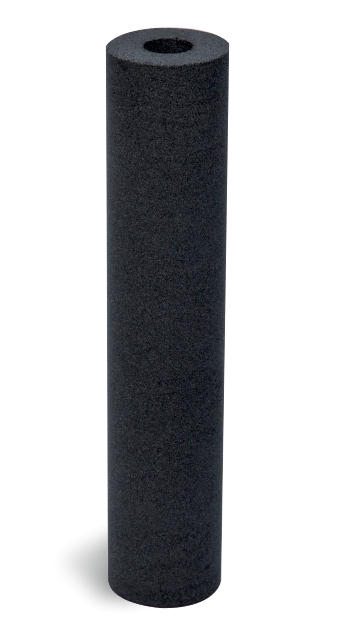
This Jyntrel product is a sintered activated carbon block filter with a nominal outer diameter of Ф40 mm and a length of 195 mm, moulded from high-iodine coconut shell carbon with food-grade ion exchange resin built into the matrix. It filters chlorine and chloramine taste and odour, organic compounds, discolouration and heavy metals such as lead and mercury, while the resin fraction softens the water and reduces scale. It is intended for appliance and equipment builders, water treatment OEMs and brand owners who need a stable CTO-stage or T33-stage cartridge for reverse osmosis purifiers, dispensers, refrigerator water systems and commercial coffee machines.
Although this stick is a liquid-phase cartridge, the design logic follows the same system discipline we apply to air filtration: define the path, the duty point and the environment before the media is fixed. Here the path runs from the supply line through the cartridge wall from outside to inside (or inside to outside depending on the housing), and the operating point is set by the feed pressure, the flow rate you draw and the pressure drop that the block presents at that flow.
Three conditions govern performance. First, flow and contact time: a higher flow through the same Ф40×195 block shortens the residence time in the carbon and resin, so an oversized pump on an undersized cartridge will pass chlorine earlier than the rated life suggests. Second, feed water quality: turbidity, hardness, iron and the chlorine load all consume capacity, and the ion exchange resin is affected by the hardness and regeneration history of the supply. Third, the mechanical environment: the sintered block is a rigid moulded body, but it should be supported in a housing that seals the end faces without imposing bending loads on the cylinder. In coffee and beverage equipment, the same cartridge sees hot or warm water and intermittent draw-off, which is a different duty cycle from a domestic reverse osmosis system running at low flow for long periods.
For air-side systems, the analogous questions are velocity, dust loading and pressure drop across the media; for liquid-side applications, they are flow, differential pressure and water chemistry. Our engineering team will map your duty point onto the cartridge geometry before confirming a specification.
The block uses 100% coconut shell activated carbon, selected for a high iodine number so that the micropore structure is well developed for chlorine, taste, odour and volatile organic compounds. Sintering binds the carbon into a uniform porous body with a fine, even pore distribution rather than a compressed granular fill, which gives a high initial flow and a stable differential pressure through life.
Filtration accuracy is fine enough to intercept particulate matter, and the moulded structure does not release loose carbon fines downstream — a point that matters where the cartridge sits ahead of a membrane or a beverage valve. The built-in food-grade ion exchange resin softens the water, reduces scaling potential and contributes to the reduction of heavy metals including lead and mercury. The carbon fraction carries the chlorine and organic load; the resin fraction carries the hardness and metal load; together they let one cartridge serve as a combined CTO and softening stage in space-constrained equipment.
Adsorption capacity is large relative to the compact Ф40×195 envelope, which supports a long service interval under typical municipal water conditions. As with any adsorption media, the actual interval depends on the feed water and the volume drawn, so we recommend setting the change-out point from your own water analysis rather than from a single fixed figure.
This cartridge is one point in a flexible size range. Standard reference dimensions include Ф60×130, Ф62×240, Ф37.5×75, Ф38×57, Ф40×195, Ф51×127, Ф32×126 and Ф32×106 mm, and the platform supports outer diameters from Ф30 to Ф60 mm. Length, diameter and the ratio between inner and outer diameter can be set to suit your housing, and end-cap welding can be configured to match your connection.
To select or customise a cartridge, send us:
With those inputs we can confirm whether the Ф40×195 standard size meets the duty or whether a custom mould is the better route.
| Item | Detail |
|---|---|
| Product name | Sintered activated carbon stick filter for water purifiers and refrigerators (carbon block / CTO filter) |
| Core filtration media | High-iodine coconut shell activated carbon with food-grade ion exchange resin |
| Core performance | Water softening and scale control, strong adsorption of residual chlorine (bleaching powder), removal of colour and odour, interception of harmful heavy metals such as lead and mercury |
| Accuracy and service life | Uniform microporous structure, high initial flow, fine filtration accuracy, no carbon fines released; large saturated adsorption capacity and long service life |
| Standard size reference (outer diameter × length, mm) | Ф60×130 / Ф62×240 / Ф37.5×75 / Ф38×57 / Ф40×195 / Ф51×127 / Ф32×126 / Ф32×106 |
| Main end applications | Household reverse osmosis purifiers (pre-filter CTO / post-filter T33), direct drinking water dispensers, built-in refrigerator water filters, commercial coffee machines |
| Size customisation | Full OEM/ODM support; length, diameter and inner/outer diameter ratio can be tooled to the device, with custom end-cap welding |
| Quality certification | Produced in a 20,000 m² facility certified to ISO 9001 and IATF 16949; filter media meet strict drinking-water hygiene standards, with quality control supported by a national-level CNAS testing centre |
The Ф40×195 format suits equipment where a compact cylindrical cartridge sits in a moulded housing. In household reverse osmosis purifiers it is used as the CTO pre-filter ahead of the membrane or as the T33 post-filter for taste polishing; in direct drinking water dispensers it provides the combined chlorine, odour and hardness duty in a single stage. Built-in refrigerator water filters use the same construction where the housing envelope allows, and commercial coffee machines use it to protect boilers and valves from scale while improving the taste of the brew water.
Because sizing is flexible, the same media can be supplied in the other reference dimensions listed above for appliances with different housing volumes. If you are specifying a new platform, the earlier in the design cycle you share the housing drawing and duty point, the more of the standard range we can apply without tooling.
Jyntrel has more than 20 years of experience in filtration research and manufacturing, with continuous export to Europe, the United States, Japan and Korea for over two decades — a supply record that supports stable, repeatable delivery for programme customers. Multiple automated production lines give a monthly capacity of several million pieces, which is what allows standard sizes and OEM runs to be scheduled without long queues.
Production takes place in a 50,000 m² plant in Zhongshan, Guangdong, China, including six clean workshops totalling 20,000 m². Quality is controlled through IQC, IPQC and OQC across the whole process, and the in-house laboratory is accredited by CNAS (China National Accreditation Service for Conformity Assessment), so filtration efficiency, dust holding capacity and resistance test reports can be issued from our own facility. The plant holds ISO 9001, ISO 14001 and ISO 45001 certification and achieved IATF 16949 certification in 2024. Products meet REACH and RoHS requirements and compliance documents can be provided. OEM/ODM support covers dimensions, structure, media grade, end-cap material, logo and packaging, and we have developed more than 1,000 filtration solutions to date.
Send us the device or vehicle model, the required size or a drawing, the airflow or water flow, the operating conditions and your quantity, and we will come back with a specification and a quotation. You can reach the team through the contact page.
The sintered block is designed for a high initial flow with a stable pressure drop, and the uniform pore structure avoids the channelling that shortens the life of granular fills. Very high flows shorten the contact time with the carbon and resin, so the rated capacity is reached sooner. Share your flow and feed pressure and we will confirm whether the Ф40×195 size or a longer body is the better fit.
We need the flow rate you draw, the feed pressure, the chlorine or chloramine level, hardness, turbidity and iron, plus the target contaminants and the operating temperature. The housing dimensions or a drawing and your annual quantity complete the picture. With these we can confirm the standard Ф40×195 cartridge or propose a custom size.
Yes. Standard reference sizes run from Ф32×106 to Ф62×240 mm, and the platform supports outer diameters from Ф30 to Ф60 mm. Length, diameter and the inner/outer diameter ratio can be tooled to your device, and end-cap welding can be configured to match your connection under OEM/ODM.
We welcome sample evaluation. Sample lead time and any sample charge depend on whether the size is standard or requires a new mould, so please state the size and the tests you plan to run. We will confirm the sample plan and the accompanying test report with the quotation.
MOQ depends on the size and packaging. Standard sizes and custom tooling carry different minimums, so the figure is confirmed with the quotation once we know the specification and annual volume. Programme customers ordering repeatedly can discuss scheduled releases.
Lead time depends on whether the order uses a standard size or a new custom mould, and on the quantity and packaging. We confirm the schedule in writing with the quotation. Multiple automated lines and a monthly capacity of several million pieces support repeat and volume orders.
Replacement depends on the feed water and the volume drawn, since chlorine load and hardness consume the carbon and resin at different rates. Set the change-out point from your own water analysis and the pressure drop you observe rather than a single fixed figure. We can advise on a monitoring interval once we have your water data.
Yes. The plant holds ISO 9001, ISO 14001 and ISO 45001 certification and achieved IATF 16949 in 2024, and products meet REACH and RoHS requirements with compliance documents available. Our in-house CNAS-accredited laboratory can issue filtration efficiency, dust holding capacity and resistance test reports. Tell us the destination market and we will confirm the document set through the <a href="/en/contact">contact page</a>.